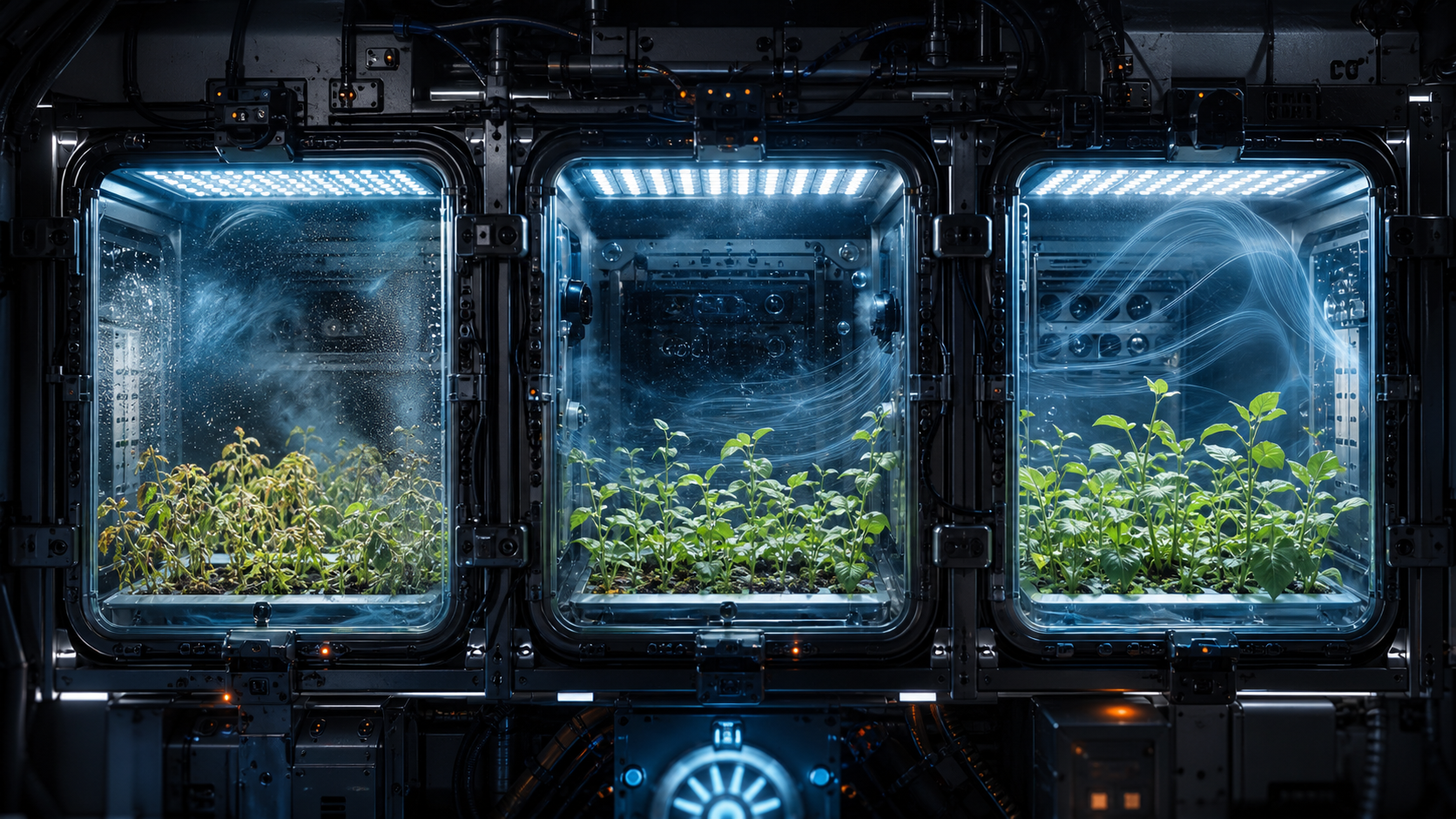
When the Cabin Plays Gravity
CHROMEX-03 on STS-54, CHROMEX-04 on STS-51, and CHROMEX-05 on STS-68 carried the same plant species, Arabidopsis thaliana, into orbit. On the first mission, the plants lived in a sealed chamber. On the second, the chamber remained sealed but received additional carbon dioxide. On the third, filtered air moved slowly between the chamber and the cabin. As the headspace improved, reproductive failure eased. A result that could have been filed under microgravity followed the air.
That progression poses an awkward question for every crop experiment beyond Earth: when a plant changes in space, how much of the response belongs to gravity, and how much belongs to the small artificial atmosphere pressed against its leaves?
The question is not academic. A lunar crop payload will experience altered gravity alongside launch vibration, radiation, unusual gas flow, humidity gradients, constrained root-zone oxygen, changing temperature, and compounds released by hardware and plants. If those exposures travel together and only the plant is measured, the experiment produces a flight effect, not a gravity mechanism. NASA may still learn that the integrated environment matters. It will not know which lever to pull next.
The CHROMEX Shuttle series shows the problem in unusually concrete terms. In the leaf study, flight plants in sealed chambers differed from matched ground controls in carbohydrate and chlorophyll concentrations. Under the ventilated condition, those flight-to-ground differences disappeared [1]. Reproduction followed the same broad progression. Development stopped early in the closed chamber, continued to pollination after carbon dioxide enrichment, and reached immature seed formation under filtered air exchange [2].
This is strong evidence that a plant's immediate atmosphere can imitate or amplify what looks like a gravity response. It is not proof that ventilation caused every difference. Headspace regime and mission changed together, so CHROMEX did not compare sealed and ventilated chambers side by side on a single flight. Mission history remained entangled with air management. The limitation does not make the series less useful. It identifies the experiment NASA would need to run to separate the variables.
GENARA-A came closer to that separation aboard the International Space Station. Researchers grew Arabidopsis seedlings in microgravity and at 1 g on an onboard centrifuge, then compared both with a 1 g ground condition. They quantified 1,484 membrane-associated proteins. Of those, 227 looked similar between microgravity and 1 g in space but differed between 1 g in space and 1 g on Earth [3]. Those 227 proteins responded to something about the flight setting other than gravity.
The experiment did not name a single culprit. Radiation, atmosphere, launch history, confinement, and hardware effects remained plausible. Its achievement was more disciplined: the onboard control removed gravity from one set of explanations. A ground control can reveal whether flight as a package changed the plant. An onboard 1 g control can reveal whether gravity was necessary for that change. Canopy-level sensing can then help identify what remains.
This hierarchy of controls also protects negative results. If microgravity and onboard 1 g plants behave alike while both differ from Earth, the experiment has not failed to find gravity. It has located the signal somewhere else in the mission environment. That finding can redirect sensors, chamber design, and the next hypothesis before another launch repeats the same ambiguity.
An earlier STS-81 experiment demonstrates how quickly interpretation can outrun measurement. Flight seedlings were smaller than ground and clinostat controls and developed denser root hairs and unusual hypocotyl hooks. The investigators proposed spacecraft ethylene as one possible explanation, but did not directly measure ethylene for that attribution. A 60-minute centrifuge stimulus tested gravitropism, not continuous growth at 1 g [4]. The observations were real. The culprit remained provisional.
Wheat supplies a second, independent warning. Earlier Mir experiments produced sterile Super Dwarf wheat heads in an atmosphere reported at 0.3 to 0.8 mg/m³ ethylene. A later test used the more ethylene-tolerant USU-Apogee cultivar and completed a seed-to-seed cycle. Twelve plants produced 508 seeds. That was 38 percent fewer than laboratory controls, but 69 percent more than Earth-grown wheat exposed to 1 mg/m³ ethylene [5]. Different crop, different system, same operational lesson: an atmospheric constituent can move an endpoint as consequential as fertility.
It would be easy to turn ethylene into the new universal explanation. That would repeat the original mistake. Carbon dioxide, volatile organic compounds, humidity, airflow, leaf boundary layers, root-zone oxygen, radiation, and acceleration can interact. The right response is not to replace gravity determinism with atmosphere determinism. It is to measure enough of the local environment that neither becomes a convenient story.
For a lunar precursor, that means sensing carbon dioxide, oxygen, humidity, temperature, pressure, volatile compounds, canopy air velocity, and root-zone conditions at the plant, not merely reporting cabin averages. A matched ground unit should replay the measured environment as closely as practical. Rotor-based variable-gravity work must declare its acceleration gradients, vibration, and hardware differences. Where mass and power allow, an onboard gravity control should sit inside the same mission history. Biological endpoints should be declared before the plants grow, and samples vulnerable to landing and recovery should be preserved or measured during exposure.
Gastronaut has placed those requirements in its Lunar Crop Precursor Concept for NASA inspection. The proposed review is specific: challenge the sensor placement, rotor controls, environmental replay, and predeclared endpoints before a payload design hardens. ORCA is a ground-stage cultivation system at approximately TRL 3 to 4. It has not flown, and its current record cannot establish performance in lunar gravity or a spacecraft atmosphere.
That boundary is precisely why the experiment matters. Early lunar missions will offer short operating windows and few chances to repeat an ambiguous result. A healthy plant or a failed harvest will not be enough if the payload cannot say which condition produced it. The three Shuttle chambers leave a durable warning: before gravity receives the credit or blame, measure the air touching the leaf.
Research foundation and evidence boundaries
The mission results and numerical findings above come from the cited plant-flight literature. Gastronaut owns the cross-study interpretation and the proposed measurement architecture. CHROMEX confounded mission with headspace regime, GENARA-A isolated non-gravity flight effects without identifying one cause, and the Mir wheat result came from a different crop and system. The precursor design remains proposed work. ORCA is approximately TRL 3 to 4, is ground-stage, and has not flown.
References
- Musgrave et al., “Changes in Arabidopsis leaf ultrastructure, chlorophyll and carbohydrate content during spaceflight depend on ventilation,” Annals of Botany (1998). DOI: 10.1006/anbo.1998.0585
- Musgrave et al., “Plant reproduction during spaceflight: importance of the gaseous environment,” Planta (1997). DOI: 10.1007/PL00008107
- Mazars et al., “Microsome-associated proteome modifications of Arabidopsis seedlings grown on board the International Space Station reveal the possible effect on plants of space stresses other than microgravity,” Plant Signaling & Behavior (2014). DOI: 10.4161/psb.29637
- Kiss et al., “Gravitropism and development of wild-type and starch-deficient mutants of Arabidopsis during spaceflight,” Physiologia Plantarum (1998). DOI: 10.1034/j.1399-3054.1998.1020403.x
- Levinskikh et al., “Growth of wheat from seed to seed in space flight,” Aerospace and Environmental Medicine (2000). PMID: 11186585