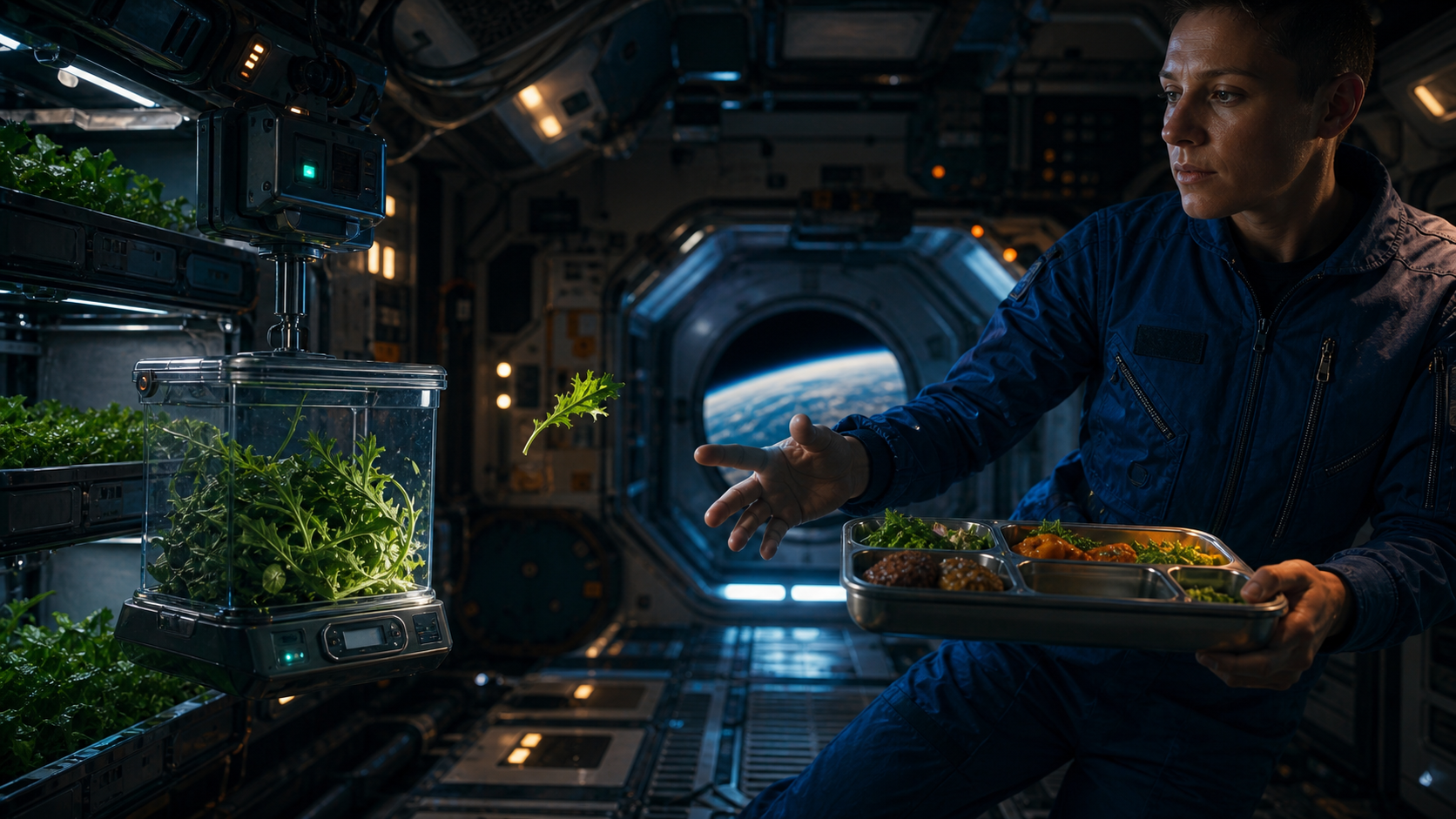
A Harvest Is Not Yet a Dose
When VEG-04 wrapped up aboard the Space Station, NASA had a massive pile of crop yield numbers. Yet nobody logged how much mizuna each astronaut actually ate. That single missing detail is what separates a basic garden trial from a real human nutrition study on orbit today in space flight operations.
When an astronaut cuts mizuna leaves in microgravity, the crew weighs the harvest and sanitizes the batch. A couple of leaves go onto a taste card while the rest might accompany dinner. Beyond that point, the published data trail simply ends somewhere between the harvest container and the astronaut's plate.
When NASA reviewed the VEG-04 results, researchers documented an impressive record of plant growth in space. Yet the published papers don't record how many grams any individual crew member swallowed, or what nutrients reached their system. That gap is what separates a simple crop demonstration from a true human countermeasure study.
The core question belongs on a basic food label: what dose actually reached the person?
When VEG-04A and VEG-04B ran matched flight and ground grow-outs in 2019, teams cultivated mizuna mustard inside the Veggie hardware. The trials tested different red, blue, and green lighting profiles along with repeated cut-and-come-again harvesting. Researchers recorded total biomass, plant chemistry, microbial counts, and sensory scores. Published records also logged hardware glitches a glossy harvest photo omits, like early over-watering and plant loss during VEG-04A [1,2].
When crew members completed taste testing, two or three astronauts participated per flight harvest. They sampled a leaf or two longer than 7.5 centimeters per light treatment, yielding 14 flight taste logs in total. Ground testing brought at least 25 evaluators per harvest, logging 79 evaluations across the study. After sampling, crew members could eat remaining sanitized greens with a meal if they chose to [1].
Those 14 flight logs confirm acceptability. The harvest weight measures production. Returned plant samples cover chemistry and food safety. But none of those metrics show what an individual crew member ate. Without that denominator, researchers can't calculate how much fresh produce contributed to an astronaut's actual diet.
This isn't a flaw in VEG-04, its thoroughness is what makes the missing link clear. The team resolved hard questions around cultivation, harvest protocols, safety, and taste. The next step is simply extending that chain to the plate.
Here's why the difference matters: yield is just supply, while intake is actual exposure. A growth chamber might yield abundant greens that astronauts leave behind, toss out, split unevenly, or run out of time to prepare. Conversely, a smaller harvest makes a real impact if its edible portion reliably delivers a fragile nutrient or fresh flavor the crew values. A scale under a crop tray can't distinguish between those outcomes.
A complete crop-to-dose record starts at harvest mass, subtracts inedible stems and sanitation losses, logs served portions, tracks leftovers, and attributes eaten grams to a specific person. Batch-matched chemistry converts those grams into target nutrient intake. The crew member's wider food log supplies dietary context. Only then can researchers state what fraction of a daily target the crop supplied.
Every step alters the final number. Light profiles and harvest timing change plant chemistry. A lab assay from one batch won't match another. Dividing a harvest equally on paper hides whether one astronaut ate most of the crop. High hedonic ratings can easily coexist with tiny portions. And consumed mass still isn't bioavailability, it's just the baseline exposure number needed to evaluate health impacts.
Tracking intake also catches useful operational findings. If a system yields well but most edible leaves go uneaten, NASA learns that plant growth is no longer the bottleneck. Portion size, prep time, taste, or menu integration becomes the new focus. That gives researchers actionable next steps rather than declaring victory on yield alone.
Closing this gap doesn't mean turning dinner into a lab chore. A scale built into the harvest container could log initial and leftover weight. Coded portion IDs could attribute servings without exposing medical records. A small retained sample from each harvest anchors chemical analysis, while a quick tablet prompt logs prep and waste. Gastronaut's Crop-to-Crew Minimum Dataset structures these fields so NASA can separate essential metrics from extra work.
The logging target must stay lean: under one minute of crew time per serving. Every added field competes with mission tasks. A protocol only earns its keep if it resolves a key decision link. A joint review with NASA nutritionists and plant scientists could test this minimum dataset against real pick-and-eat workflows to cut redundant steps.
Short lunar missions make this data more urgent, not less. A one-week surface stay won't prove long-term health benefits, but it can measure edible mass fractions, serving distributions, crew variations, and nutrient yields per watt, liter, and crew minute. Those early numbers refine long-duration system designs without making premature physiological claims.
NASA might hold unpublished intake logs or operational notes outside the open literature. If so, a quick technical review can clarify existing records and avoid redundant protocols. Gastronaut's analysis maps what is visible in the published VEG-04 record, where consumed mass remains unlinked to batch chemistry.
Gastronaut is building ORCA as a ground-stage cultivation and sensing platform (TRL 3–4) that has not flown. It carries no human health claims. Its role in this discussion is a candidate tool for future crop-to-dose studies, subject to NASA review of its sensors, safety controls, and crew workflow impact.
Future space crop studies don't need to claim that eating a leaf prevents disease. They just need to trace that leaf from chamber to mouth. When the harvest bag leaves the scale, the measurement shouldn't stop.
Research foundation and evidence boundaries
VEG-04 metrics come directly from cited publications. Gastronaut developed the evidence map, crop-to-dose framework, and proposed minimum dataset. This analysis reflects the published record and does not rule out internal NASA data. Consumed mass establishes exposure rather than health efficacy. ORCA is ground-stage hardware (TRL 3–4) with no flight history or health claims.
References
- Bunchek et al., “Pick-and-eat space crop production flight testing on the International Space Station,” Journal of Plant Interactions (2024). DOI: 10.1080/17429145.2023.2292220
- NASA Technical Reports Server, “Pick-and-Eat Space Crop Production Flight Testing on the International Space Station,” NTRS document 20240000823. NTRS record