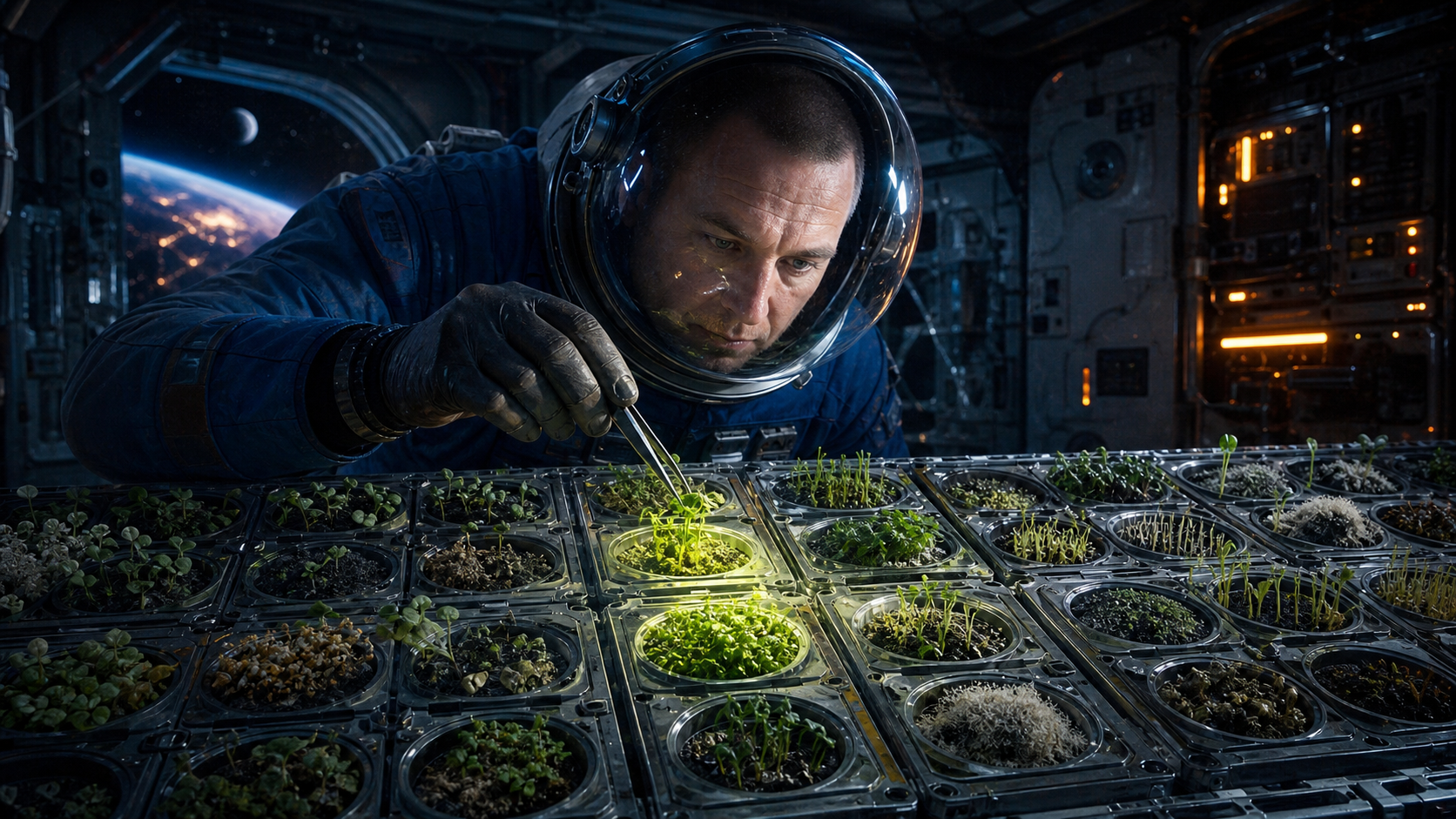
Sixty Crops Entered. Eighteen Advanced.
Sixty microgreen species went into a NASA screen. Eighteen cultivars came out the other side. What eliminated the rest wasn't exotic biology or futuristic chemistry, it was the kind of thing a home gardener would recognize. Some seeds germinated poorly. Others grew so close to the substrate that a clean harvest wasn't possible. Large seeds wouldn't shed their coats. Sunflower seed coats, in particular, carried visible fungus. Two of the finalists made it through the biology only to lose favor later because people didn't like eating them [1].
That's what crop readiness looks like before anyone takes the launch photograph. It's a sieve built from mundane constraints, and any one of them can end a mission use case on its own.
So the question NASA's published microgreens work actually names is more demanding than whether fast-growing greens can sprout. It's whether one specified cultivar can stay productive, safe, nutritious, harvestable, and acceptable once the cultivation hardware starts to resemble the system that would actually carry it.
The 2023 Kennedy Space Center study tested candidates at 23°C, 3,000 ppm carbon dioxide, and a light intensity of 150 µmol m⁻² s⁻¹. Researchers measured morphology, germination, true-leaf emergence, height, yield, nutrient composition, microbiology, and sensory acceptance [1]. None of that reproduced a lunar habitat, and it wasn't meant to. It was a controlled ground setting built so a large candidate pool could fail cheaply, and informatively.
The nutritional data pushed back on the idea that microgreens form one interchangeable category, too. Dwarf Grey Sugar pea reached 5.88 percent protein by fresh weight and 57 kilocalories per 100 grams. Cilantro led the tested group in carbohydrate, fat, and potassium, while white kohlrabi produced the highest measured calcium concentration [1]. Which candidate is "correct" depends entirely on the mission need: a crop selected for compact geometry is not necessarily the crop that wins on calcium, flavor, protein, or ease of harvest.
Microbial results add a further constraint. Freshly harvested microgreens carried higher microbial counts than other leafy greens grown in controlled environments at Kennedy [1]. That's not a finding that the crops were unsafe. It's a reason to keep seed sanitation, substrate choice, root-zone containment, harvest tools, and release criteria built into the development program from the start, because the crop only becomes food once those controls travel with it.
NASA's Crop Readiness Level framework gives this progression a useful grammar. The 2023 paper reported that its own work advanced the studied microgreens to CRL 3, and it separately cited 2022 work by Hummerick and colleagues as moving those crops to CRL 4 [1]. The distinction is easy to blur but worth preserving carefully: the CRL 4 statement belongs to the later work the paper cites, not to the CRL 3 experiment it actually ran.
From there the authors pointed toward flight-forward hardware and additional food-safety testing, and that's the real integration gate. A cultivar that screens well on a bench, or in a terrestrial chamber, can behave differently once irrigation becomes constrained, air moves differently through a dense canopy, roots have to stay contained, surfaces need sanitizing, and every crew interaction carries a real time cost. Hardware isn't just a box wrapped around established crop biology at that point. It becomes part of the crop's evidence.
A 2025 NASA record shows the program is still developmental. It describes Siberian kale and other microgreens grown for eight days on a random positioning machine, alongside seed-film work, biodegradable substrate, antifungal treatments, plate counts, residue testing, and microbial-community sequencing [2]. The record states plainly that microgreens had not yet been cultivated in spaceflight. Random positioning can surface responses worth pursuing further, but it remains a ground simulation, with its own acceleration gradients and its own mechanical artifacts.
Read together, this body of work should make a commercial developer both more modest and more ambitious at once. More modest, because a tray of healthy seedlings doesn't confer food readiness by itself. More ambitious, because NASA has already done the hard part of supplying the selection logic and naming the missing test environment. What's left is the work of carrying one named cultivar through the next gate with evidence that can be traced.
Gastronaut is developing ORCA as an atmosphere-controlled cultivation and measurement platform. ORCA remains a ground-stage system at approximately TRL 3 to 4, and it has not flown. Gastronaut has not completed a formal public Crop Readiness Level assessment for a named cultivar grown in the system, and for good reason: a hardware TRL can't be borrowed by the crop, and a crop's CRL can't be transferred to new hardware just by association.
The next credible act, then, is an assessment rather than a maturity claim. Gastronaut has prepared a Crop Readiness Self-Assessment that NASA crop researchers could challenge against one cultivar already present in the microgreens evidence base. The review would ask whether tray and canopy geometry actually fit, whether root containment and air management stay controlled, how microbial loads change between seed and harvest tool, whether batch nutrition and sensory results hold up, and, critically, which failed criterion would be enough to stop advancement.
That last question, the stop criterion, is what gives the whole exercise its value. A development team should know, before running a test, whether persistent seed-coat retention, an unacceptable microbial trend, poor harvest recovery, or inadequate nutrient delivery would send a cultivar backward rather than forward. Without that, every result can be narrated as progress regardless of what it actually shows. A readiness framework earns credibility precisely when it's willing to disqualify a favorite candidate, and to preserve the reason why for whichever team encounters it next.
The review would also need to sort out where each question actually belongs. Germination reliability, sanitation chemistry, airflow, harvest geometry, and plenty of other failure modes can be tested on Earth. A ground simulator can screen how a crop responds to altered orientation. An uncrewed lunar payload could test integrated hardware and crop behavior under the real surface environment, without claiming anything about crew health. Consumption and dietary contribution are a different matter entirely; those require a crew study with appropriate oversight.
NASA doesn't need another broad promise that microgreens are well suited to exploration. Its own research has already moved past that sentence. Sixty candidates went into the sieve, and eighteen came out. The next real advance happens when one cultivar enters representative hardware and every reason it might fail is allowed to count.
Research foundation and evidence boundaries
The screening conditions, the down-selection, the nutritional examples, the CRL statements, and the 2025 development status all come from the cited NASA records. Gastronaut owns the integration argument and the proposed use of its self-assessment, nothing more. Random positioning is a ground simulation. The CRL 4 statement refers to work separate from the 2023 CRL 3 experiment. No formal public CRL has been assigned to an ORCA crop-system pairing. ORCA is approximately TRL 3 to 4, is ground-stage, and has not flown.
References
- Spencer et al., "Novel Microgreen Crop Testing for Space," 52nd International Conference on Environmental Systems (2023), NASA document 20230007372. NTRS record
- Mickens, "Recent Efforts to Advance Microgreens as a Space Crop" (2025), NASA document 20250008449. NTRS record