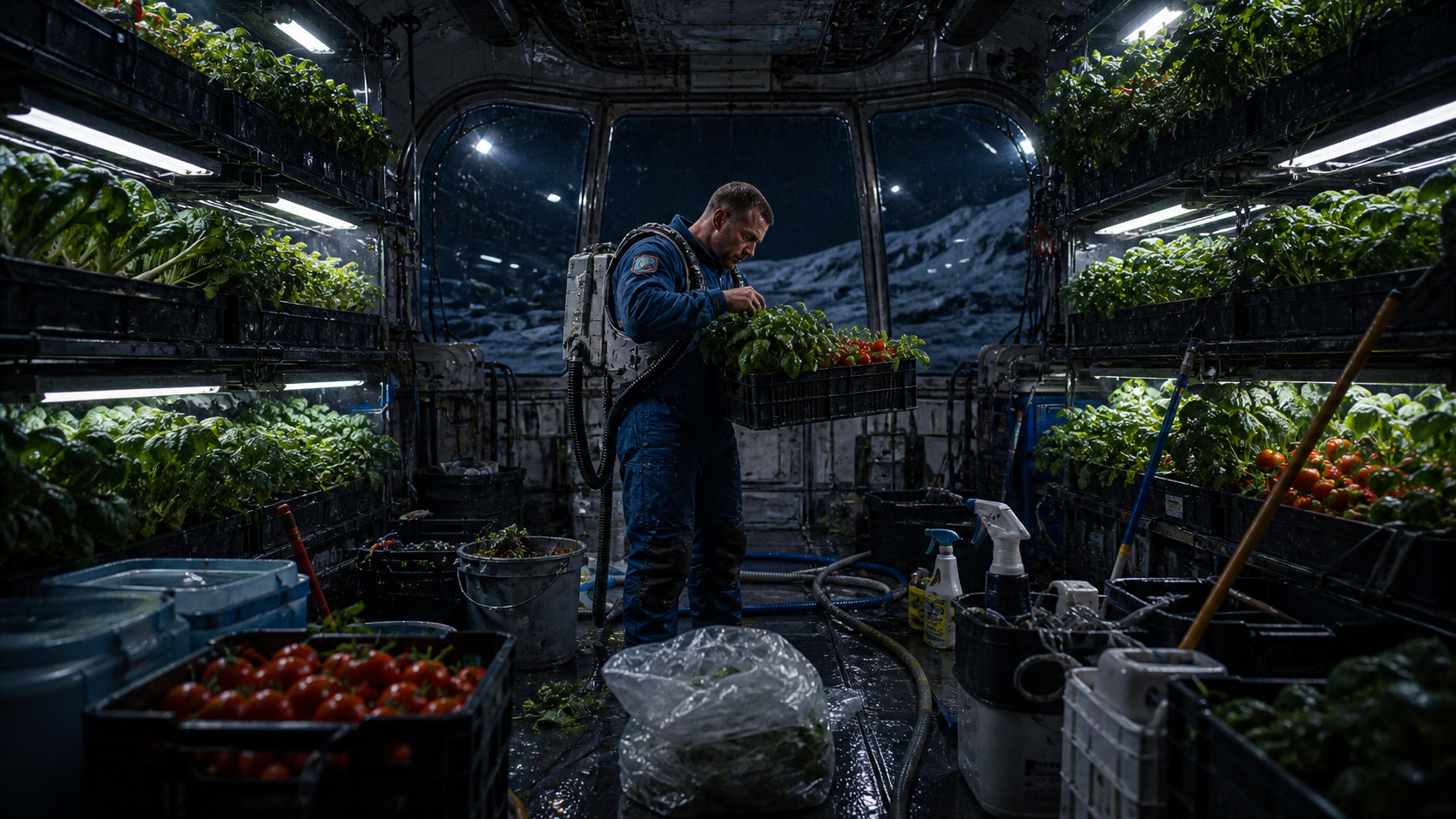
Six Hours Inside a Kilogram
At Neumayer Station III in Antarctica, the 2019 EDEN ISS greenhouse season consumed 694.5 crew-member hours. The researchers normalized that labor to 6.31 hours for each kilogram of edible biomass [1]. Every kilogram carried most of a working day inside it.
The number is one of the clearest operational baselines in space-crop research. It is also a trap for anyone who wants one figure to stand in for a lunar greenhouse.
EDEN ISS is a terrestrial analog with its own crop mix, scale, support structure, maintenance environment, and mission purpose. The project reported 646 kilograms of edible biomass across the separate 2018 and 2019 experimental phases. The 694.5-hour total and the 6.31-hour rate belong to the 2019 crew-time analysis [1]. Recombining those quantities outside their reporting frames would manufacture a new result rather than clarify the old one.
Used honestly, 6.31 is not a lunar estimate. It is a challenge: what exactly does an autonomous crop system have to do before qualified crew attention falls below that bounded analog rate without sacrificing yield, safety, or recovery from failure?
Crew time is often hidden behind mass, power, water, and volume because those resources fit naturally into engineering budgets. Attention is different. It arrives in minutes spread across planting, thinning, inspection, nutrient management, harvesting, cleaning, food preparation, troubleshooting, repair, recordkeeping, and conversations with specialists on Earth. A weekly total compresses those activities until the operations risk disappears.
Gastronaut's evidence synthesis found two complementary records. Zeidler and colleagues provide the normalized EDEN ISS rate [1]. Poulet and colleagues provide a NASA activity taxonomy drawn across ISS Veggie and four ground analogs: EDEN ISS, HI-SEAS, ILMAH, and the Mars Desert Research Station [2]. Their hierarchy moves from category to subcategory, activity, and sub-activity, covering work such as planting, daily operations, harvesting, water management, maintenance, repair, plant science, and meetings.
The numerical bar values in the NASA presentation have not been independently extracted and checked by Gastronaut, so they are not reproduced here. That boundary makes the evidence stronger, not weaker. One source supports an hours-per-kilogram comparator. The other supports a common activity structure. Neither establishes a universal rate for lunar operations.
The activity structure reveals why averages can mislead. Startup work is not steady-state work. A pump failure can dominate a week that otherwise appears automated. Harvest burden depends on crop architecture. Sanitation and meal preparation may sit outside greenhouse operations while still drawing from the same crew schedule. Remote assistance can reduce hands-on time aboard the mission while adding communications, dependency, and ground labor.
EDEN ISS reported onsite operator time at roughly four times remote-support time, excluding planning for the next mission [1]. That is not a verdict against remote operations. It is an accounting instruction. When labor moves from the habitat to Earth, it has changed location, not vanished.
The denominator changes the decision as much as the numerator. Crew minutes per week answer a scheduling question. Minutes per kilogram answer a production-efficiency question. Minutes per accepted serving answer a food-service question. Minutes per delivered amount of a target nutrient or bioactive answer a countermeasure question. Ground-support minutes and communications events per crop cycle answer an autonomy question.
For a supplemental microgreen system, kilograms may be the least revealing denominator. A small harvest could contribute a scarce nutrient, a valued fresh-food event, or dietary variety. It could also demand repeated intervention for a contribution too small to matter. Only a set of linked denominators can distinguish those cases.
Distribution matters too. The mean crew time can remain low while one clogged water line creates an operationally unacceptable interruption. A lunar campaign should report the longest intervention, high-percentile task time, failed and partially lost cycles, and the difference between novice and steady-state operation. A crop system must be judged on the bad day as well as the average one.
That is why autonomy should be tested through recoverable faults. A ground campaign can introduce sensor drift, a clogged water path, uneven germination, canopy obstruction, a microbial warning, or a communications outage. The system can then be scored on detection, diagnosis, recovery, crop loss, crew intervention, and remote-support demand. Sensors and software are inputs. Reduced work with preserved outcomes is the result.
Recovery time should be tied to mission consequence. Ten minutes spent acknowledging a harmless alert is not equivalent to ten minutes during a surface excursion or sleep period. A labor record needs timing, urgency, and interruption cost as well as duration.
Gastronaut has incorporated these fields into its Crop-to-Crew Minimum Dataset and Crop-System Resource Accounting Template. The next inspectable step is a 30-day ORCA ground protocol using the NASA activity taxonomy, raw event logs, separated crew and ground labor, and declared fault scenarios. EDEN ISS's 6.31-hour rate would remain a comparator with its setting attached, not a target disguised as a forecast.
ORCA is a ground-stage system at approximately TRL 3 to 4 and has not flown. Gastronaut does not currently publish a source-traceable, independently reviewed ORCA crew-time rate. Any development target must remain a target until a timed campaign identifies the operators, task list, duration, exceptions, outcomes, and denominators.
NASA can learn a great deal about crew burden during a short lunar mission even when health effects require longer observation. It can measure how often cultivation interrupts surface work, which tasks resist automation, how communications delay shifts labor onboard, and whether the food delivered justifies the attention spent. Those results would improve habitat operations, life-support trades, and future protocol design.
The Antarctic kilogram should not be carried to the Moon as a prediction. It should be carried as a clock. Until every hour inside the harvest is visible, autonomy remains a description rather than a measured outcome.
Research foundation and evidence boundaries
The EDEN ISS labor values and onsite-to-remote relationship come from Zeidler et al.; the cross-setting activity taxonomy comes from the cited NASA presentation. Gastronaut owns the synthesis and proposed protocol. The 646-kilogram project total must not be recombined with the separate 2019 labor frame. Presentation bar values remain unquoted because Gastronaut has not independently extracted them. ORCA has no validated crew-time rate, is ground-stage at approximately TRL 3 to 4, and has not flown.
References
- Zeidler et al., “Crew time and workload in the EDEN ISS greenhouse in Antarctica,” Life Sciences in Space Research (2021). DOI: 10.1016/j.lssr.2021.06.003
- Poulet et al., “Crew Time Requirements in Future Space Greenhouses: What Can We Infer from Current Analog and Space Missions?” (2021), NASA document 20210023241. NTRS record