When Pressure Moves but the Eye Does Not
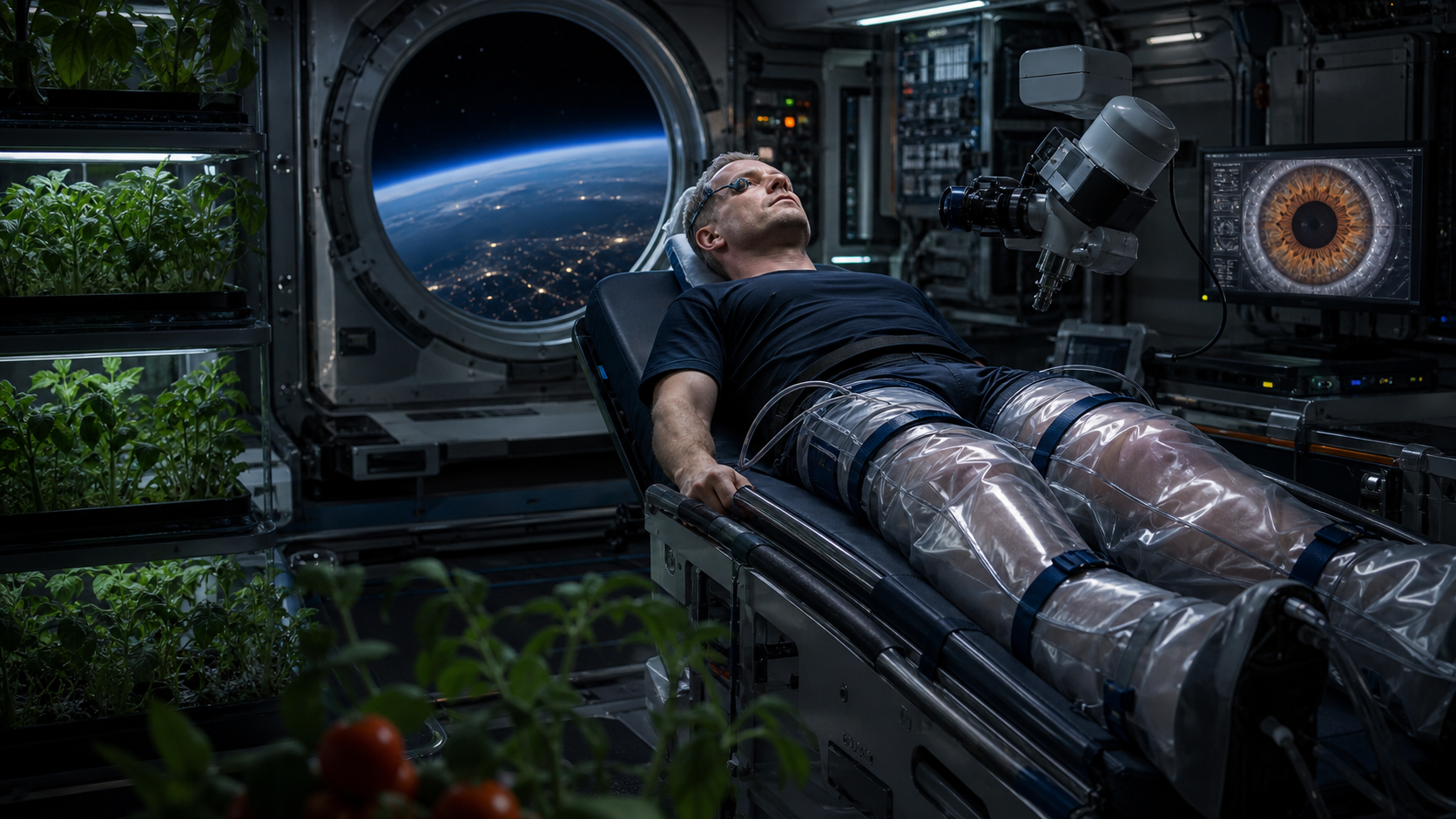
Fourteen astronauts entered a lower-body negative-pressure protocol aboard the International Space Station. At 25 mmHg, the intervention drew fluid toward the legs and returned intraocular pressure to a value comparable with the preflight seated condition. The number moved in the intended direction. Choroidal thickness did not. In one experiment, a promising mechanical action and an unchanged ocular structure occupied the same result.
That split is more than a physiological curiosity. It asks the question that should govern every countermeasure proposed for spaceflight-associated neuro-ocular syndrome: what, exactly, has been protected? Changing a pressure or fluid measure can show that an intervention reached a pathway. It cannot, by itself, show that the optic nerve head, retina, or visual function survived the exposure better.
Greenwald and colleagues made the distinction visible because they measured both sides of it. Their lower-body negative-pressure intervention reduced intraocular pressure during flight but did not reduce choroidal thickness. Pardon and colleagues examined structural outcomes in the same 14-member NASA Fluid Shifts Study cohort. By flight day 150, the crew showed changes in minimum rim width, optic cup volume, Bruch membrane opening height, and macular thickness. Brief in-flight lower-body negative pressure did not alter those structural parameters.
This does not disprove lower-body negative pressure. The exposures lasted only about ten to twenty minutes, and a longer or differently dosed intervention could produce another result. SANS may also arise from several interacting causes, some of which a fluid-shift intervention will not address. The studies establish a narrower, more consequential point: a favorable proxy result cannot carry a structural protection claim across the gap between them.
Gastronaut found the same gap at the level of the literature. We coded 56 records involving lower-body negative pressure, venoconstrictive thigh cuffs, or closely related mechanical implementations. Only 5 centered on ocular structural outcomes. Thirty-three centered on pressure or fluid measures, and 18 on cardiovascular response or tolerability. The distribution is lopsided because the early questions are practical. Can the device move fluid? Can the crew tolerate it? Can investigators measure the response safely and repeatedly? Those are necessary questions. They are not the final ones.
The counts also require discipline. They describe Gastronaut's captured evidence set, not every SANS publication. Some rows report mixed, nondirectional, or unstated results, so the map is not an efficacy tally. An independent second-coder check remains pending, especially for records that contain several endpoint families. The 56-record endpoint map and coding note expose the classifications and their rules. The boundary is part of the finding, because the purpose is to see where the field has looked, not to declare which device works.
Why do proxies dominate? Structural imaging in flight requires calibrated equipment, trained crew time, image-quality control, and longitudinal scheduling. Tolerability must be established before exposure can be extended. Pressure and flow measures can often be collected faster and more often. In a constrained spacecraft, the feasible endpoint naturally becomes the familiar endpoint. Over time, familiarity can harden into significance: the measure that can be taken begins to stand in for the outcome that needs to be known.
Lunar operations will intensify that temptation. A short surface mission will force investigators to bargain for minutes, data volume, equipment, and crew attention. The easiest study will be one that demonstrates an immediate physiological movement. The useful study will connect that movement to a ladder of consequences: intervention dose and exposure, pressure or fluid response, ocular structure, visual function, and persistence after the intervention and mission.
Each rung supports a different claim. A change in intraocular pressure can establish an acute physiological response. Optical coherence tomography can show whether relevant tissue changed. Acuity, refraction, contrast sensitivity, and other mission-appropriate tests can show whether vision changed. Matched pre-mission, in-mission, and post-mission measurements can show whether an effect resolves, stabilizes, or progresses. No rung becomes dispensable because the one below it moved.
The same rule should govern crop and nutrition research. A food can contain a compound associated with a relevant pathway. A crew member can consume a measurable dose. A biomarker can respond. None of those observations alone establishes protection of ocular structure or vision. A credible crop-to-eye study must preserve the chain from crop composition and actual intake through pathway response to a functional or structural endpoint. Gastronaut treats that chain as a proposed research architecture. ORCA is a ground-stage crop platform at approximately TRL 3 to 4, has not flown, and does not currently prevent SANS.
NASA can make the missing endpoint harder to miss by defining a minimum SANS measurement set for lunar studies before payload and crew-time trades begin. That set need not force every investigation to carry the entire clinical burden. It should require each proposal to state where it enters the ladder, what later endpoint would be needed to support a stronger claim, and how its measurements can join a longer series. A short mission can then establish repeatability and acute response without being mistaken for the final answer.
Gastronaut is ready to put its endpoint map in front of NASA ocular-health, Human Research Program, and countermeasure investigators and help test a practical minimum set against lunar crew-time constraints. The review question is concrete: which pressure, structural, functional, and persistence measures can travel together without making the protocol operationally impossible?
The first ISS result remains the right image for that decision. The pressure number came home. The tissue measure stayed where it was. A SANS countermeasure should be judged by the eye it protects, not only by the gauge it moves.
Research foundation and evidence boundaries
The 14-person findings come from two peer-reviewed studies associated with NASA's Fluid Shifts Study. Gastronaut owns the 56-record endpoint synthesis and the 5 structural, 33 pressure or fluid, and 18 cardiovascular or tolerability classification. That map is a bounded research set, includes nondirectional records, and awaits an independent second-coder check. It does not establish that mechanical countermeasures fail. Any crop-to-SANS pathway or ORCA study described here is proposed work; ORCA has not flown and carries no present SANS-prevention claim.
References
- Greenwald, Scott H., et al. "Intraocular Pressure and Choroidal Thickness Respond Differently to Lower Body Negative Pressure During Spaceflight." Journal of Applied Physiology, 2021. https://doi.org/10.1152/japplphysiol.01040.2020
- Pardon, Laura P., et al. "Changes in Optic Nerve Head and Retinal Morphology During Spaceflight and Acute Fluid Shift Reversal." JAMA Ophthalmology, 2022. https://doi.org/10.1001/jamaophthalmol.2022.1946