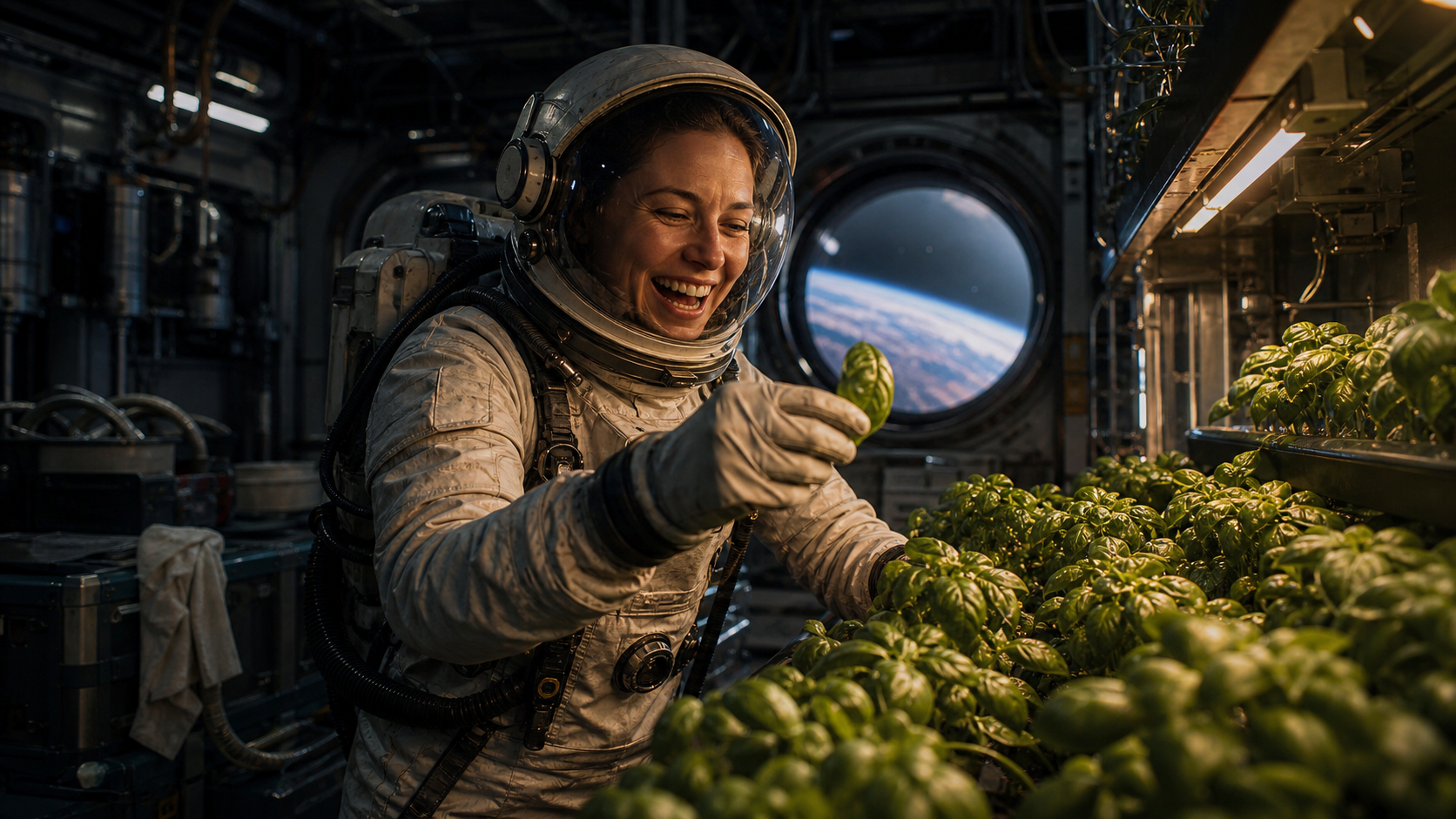
The Best Part Was Eating the Plant
Crew members rated seeing their crops grow and enjoying a meal made from their crops as the best aspects of having a crop habitat onboard. Those two activities ranked number one. Cleaning up was the worst. The survey turned a morale opportunity into a design requirement.
This is a good example of how designers can use research to find opportunities to build a better product. Designers rarely allocate resources such as mass, power, space, accessibility, and crew time on the basis of morale. But they do need to know which interactions with a living crop add value and which simply require additional work.
Designers can ask the narrower question about which experiences with a crop provide value versus creating work, and design researchers can help them find answers. Lauren Blackwell Landon and her team had 27 long-duration ISS astronauts complete three surveys: prior to launch, during the time their crop was growing, and after they completed their mission. The questions included items related to engagement, ease, meaningfulness, mood, wellbeing, performance, connections to Earth, sensory experience, and the desire to harvest or consume the crop. Overall, the crew members found working with the crop highly engaging and meaningful. Their descriptions indicated that the sights, smells, tastes, and touch of the crop became more positive over time. Smell, taste, and touch showed the strongest association with time, and recent crop interaction was associated with more favorable visual and olfactory ratings.
This research is valuable because it identified the weakest area. General interaction with the crop was correlated with overall mood rating before adjustment for multiple comparisons, but it missed the adjusted significance threshold. We therefore cannot conclude that exposure to any type of plant increased mood. Instead, the correlations with mood that remained significant were primarily associated with either voluntary viewing or consumption of the crops. Both of those are the top-ranked activities preferred by crew members.
The fact that crew members distinguished between different types of interactions with the crop has implications for hardware. Although the crop chamber can produce edible biomass, that does not necessarily mean much of it will reach a crew member's plate. Similarly, the schedule required for photography, sanitation, and cleanup can consume much of the time available for other uses, including viewing or tasting. Combine all of those times into one category labeled "interaction with the crop" and the system masks your ability to determine which design trades are occurring inside it.
Like lighting, accessibility to viewing the plants matters. The plants need to be visible without compromising environmental control or contaminating the habitat, and canopy color, light levels, and sight lines may influence whether a crew member decides to look. Although voluntary viewing was an enjoyable activity by the crew members' own responses, they did not spend a great deal of time looking. Any system intended to allow sensory contact between the crew member and the plants should make that contact easily accessible, and preferably automatic, so it does not require a scheduled procedure.
Eating them requires the same care. When a meal is prepared using the crop grown in the chamber, it combines sensory novelty, participation in growing food, and nutritional content into one experience. But if the edible portion is not safe to eat, not visually appealing, or simply wasted, none of those benefits reach the crew member. Future protocols developed for lunar missions that include crop production should relate the size of the harvest lot to the portion offered, the mass consumed, and the meal context, and should assess immediately how the crew member senses and responds to eating their own crop-grown food. If either of those links is broken, scientists may collect leaf counts and crew surveys for years and never learn whether the food changed intake or dietary habits.
The lowest-rated activity may carry the greatest design leverage. Cleanup ranked last because it arrives after the visible reward, poses contamination risk, involves awkward handling, and consumes crew time. Reducing those burdens can improve both the quality of the crew's experience and the efficiency of operations. Possible design options include contained root zones, tool-free access, cleanable surfaces, simplified harvest interfaces, and automated logging.
NASA can take astronaut-defined behaviors and translate them into an actionable protocol. Each task, meaning setup, tending, viewing, harvesting, eating, sanitizing, sampling, troubleshooting, and cleanup, can carry its own time record. Each can also be connected to measures of enjoyment, sensory response, mood, intake, and disruptions. That structure would let NASA determine whether value comes from the presence of live plants, from being allowed to choose to interact with them, from the meal itself, from the novelty, or from a combination that shifts with mission duration.
A second reason task resolution helps is that it prevents automation from becoming an all-or-nothing proposition. Watering, imaging, and environmental control may continue to operate autonomously, while voluntary viewing, harvest, and eating remain explicitly in human hands. Cleanup may be partly automated precisely because it sits near the bottom of the rankings. The design issue is not how to remove humans from interacting with crops. It is which human moments warrant protection and which machine tasks should recede into the background, measured in minutes as well as survey scores.
The objection is obvious. These results rest on self-reported survey data gathered from astronauts who were willing participants in studying their own behavior. Astronauts who chose to view or consume the plants may already have differed in mood, appetite, workload, or interest. The study did not randomly assign astronauts to enjoyable and unenjoyable crop tasks, and it did not demonstrate a clinically relevant mental-health effect. Those limits rule out a therapeutic claim. They do not erase the design signal. When crew members consistently distinguish among tasks, a system that treats those tasks as identical is discarding information.
Gastronaut treats this research as providing design parameters for ORCA, not as validating outcomes. ORCA is a ground-stage platform at roughly TRL 3 to 4 and has not flown. It carries no documented behavioral-health benefit. What it contributes is a structural framework for measuring linked field elements, meaning crop events, task burden, food offered, food consumed, and acute crew response, that can be applied toward a short lunar protocol. The Crop-to-Crew Minimum Dataset is ready for NASA critique.
A targeted review among NASA behavioral-health, food, crop-production, and operations specialists could refine which linked fields belong in one short lunar protocol, how many can be captured automatically, and which require scarce crew input. The goal is not to burden an early lunar surface mission with a large-scale psychology study. It is to keep the most valuable characteristics of a lunar crop system from disappearing beneath an aggregate interaction score.
The astronauts already gave the first design review. They wanted to see their crops grow. They wanted to eat them. They did not want the reward buried beneath cleanup. A lunar crop system should be built around that order.
Research foundation and evidence boundaries
The principal source followed 27 long-duration ISS astronauts with surveys before flight, during crop growth, and after their missions ended. It reported increasingly pleasant sensory experience over time and stronger adjusted associations around voluntary viewing or consumption than around broad crop interaction. The study was observational and self-reported, so it cannot establish causation or a clinical mental-health effect. Gastronaut owns the proposed task-to-intake measurement synthesis. ORCA has not flown and carries no present behavioral-health claim.
References
- Landon, Lauren Blackwell, et al. "Sustaining the Merry Space Farmer With Pick-and-Eat Crop Production." npj Microgravity, 2025. https://doi.org/10.1038/s41526-025-00513-9