A Harvest Is Not a Life-Support System
Raymond Wheeler gathered nearly four decades of NASA crop research into a single technical memorandum in 2009. He could have used the document to celebrate everything plants had already done in controlled chambers and spacecraft; instead he laid out a sequence. Keep the ground program alive. Integrate crops with the other life-support subsystems. Test them in space. Begin with supplemental vegetables, and expand only after operating experience has accumulated.
That restraint turned out to be the enduring architecture. A plant can germinate, mature, and be harvested while the food system around it remains incomplete, which is precisely why the harder question sits elsewhere: when does a crop become a dependable life-support service, one that delivers edible nutrition on schedule, uses known resources, survives faults, protects the crew, and interacts predictably with water, atmosphere, materials, and waste?
NASA's BIO-Plex planning shows the scale of the ambition it was reaching for. The concept targeted a diet that was 90 percent crop-derived for a crew of four, split between 45 percent produced inside the system and 45 percent stowed crop food, with the remaining 10 percent coming from noncrop food. One conceptual production module worked out to roughly 80 square meters of growing area inside 185 cubic meters of volume.
Those numbers tend to stick in memory because they read like a finished architecture. They weren't. They were targets and concepts, not demonstrated closure. The actual development sequence began much smaller, closer to two square meters of vegetable production, moved toward a ten-square-meter class system, and only contemplated larger modules once smaller units had built a track record. Reliability was meant to emerge from staged operation over time. It was never awarded by the size of a drawing.
Wheeler's report also preserved a mismatch worth sitting with: a crop cycle may run two or three months, but the pumps, lights, sensors, controls, water loops, and human procedures that support it can fail on any given day. A successful harvest reports on one biological interval. A life-support claim has to report on repeated intervals, including whichever cycle happens to be the one where a valve sticks, contamination appears, a seed lot underperforms, or crew attention simply isn't available.
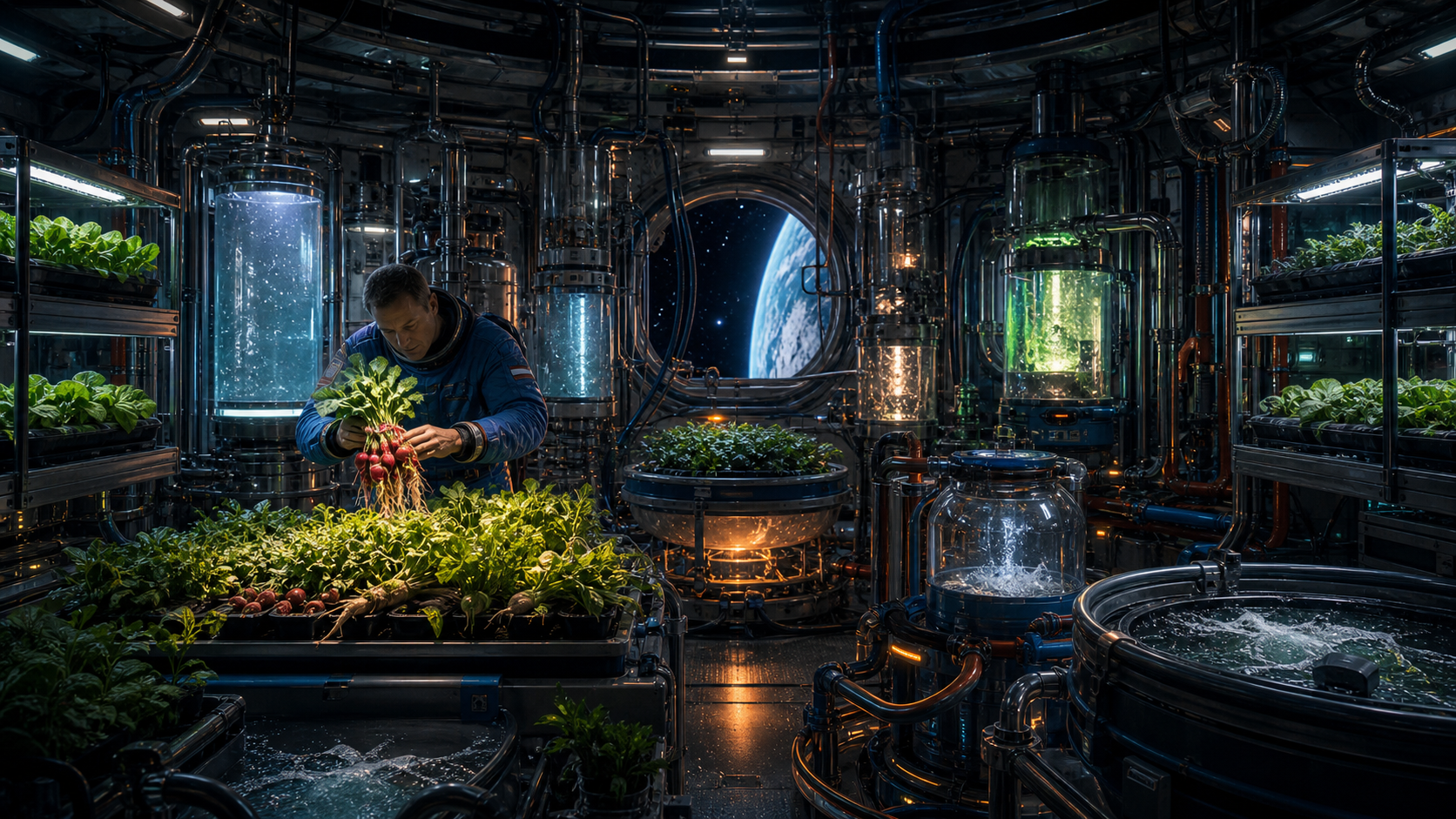
The International Space Station carried this lineage from planning into repeated flight experience. Veggie let crew members handle and consume crops directly. The Advanced Plant Habitat added tighter environmental control and deeper plant-science capability on top of that. Together the two systems built up knowledge across lighting, water delivery, cultivation, microbial monitoring, harvest, sensory evaluation, and crew procedures, and they also exposed something less visible: the labor hidden between a seed and a bite. Setup. Thinning. Debris removal. Pollination. Photography. Sanitation. Sampling. Cleanup.
NASA records describe Ohalo III as the next transition, one that draws on both Veggie and the Advanced Plant Habitat to build a more operational crop-production testbed aimed at Moon and Mars exploration. Published plans discuss candidate-crop testing, crop-system development, and implementation of a pick-and-eat food-safety program, and the verbs there are deliberately prospective. Development, testing, implementation: these describe movement along a lineage, not certification that a closed food loop already exists.
The EDEN ISS greenhouse in Antarctica put another missing quantity on the ledger. Across its 2018 and 2019 experiment phases the project reported 646 kilograms of edible biomass. For the 2019 phase specifically, labor totaled 694.5 crew-member hours, working out to 6.31 hours for every kilogram of edible biomass produced. Note that the first figure spans two phases while the second normalizes labor for just one of them; combining the two outside those separate frames would manufacture a result the study never actually reported.
EDEN ISS is an analog, not a lunar forecast, but 6.31 hours per kilogram still makes the underlying operating problem visible. A crop system draws on more than electrical power and water. It draws on trained attention, remote support, troubleshooting, cleaning, and recovery, and in this particular analog, on-site operator time ran about four times remote-support time, excluding planning for the next mission. Communication delays will shift that balance on the Moon, and shift it far more sharply on the way to Mars.
This is the reasoning behind treating loop closure as a time series rather than a single percentage. Food needs records of edible mass, calories, nutrients, losses, and actual intake. Water needs inputs, recovery, cleaning demand, solution losses, and quality tracked over time. Atmosphere needs carbon dioxide uptake, oxygen generation, trace gases, and the habitat interface accounted for. Materials need seeds, substrate, nutrients, packaging, replacement parts, inedible biomass, and waste disposition on the books. And operations need crew time, automation, maintenance, remote support, and recovery from failure counted honestly, cycle after cycle.
These ledgers have to share a clock and a boundary, or they stop meaning much. Gross oxygen production can't be presented as a net habitat contribution if the accounting quietly excludes dark respiration or supporting equipment. Water recovered from transpiration has to travel alongside water spent on cleaning and losses, not separately from it. Edible harvest has to be kept distinct from the portion actually consumed. A system that performs beautifully across three nominal cycles and then consumes an extraordinary amount of effort recovering from one contamination event has a genuinely different value than its average yield would suggest.
Gastronaut's place in this lineage is to produce comparable ground evidence before asking NASA to infer operational value from it. ORCA is a ground-stage platform at approximately TRL 3 to 4, and it has not flown. It has not demonstrated bioregenerative closure. A credible campaign for it would need to record edible output, nutrient composition, input mass, water movement, gas exchange, power, crew-equivalent labor, cleaning burden, fault recovery, and consumption across both successful and failed cycles alike. The Crop-System Resource Accounting Template is designed to make those boundaries inspectable rather than assumed.
NASA crop-production, life-support, food, and human-health specialists could test that template now against one bounded ORCA ground campaign. A requirements-trace workshop could map every measurement to crop readiness, to Ohalo III research needs, and to bioregenerative metrics, then identify plainly which claims still sit outside the data. The result would be a ledger NASA can challenge, rather than a performance story it has to take on faith.
The old roadmap was never pointing toward one triumphant harvest. It points toward a service that keeps working after the photograph is taken, through the next cycle and the fault after that. A crop becomes life support only when its ledger survives for as long as the plants do.
Research foundation and evidence boundaries
NASA's historical roadmap, BIO-Plex targets, ISS crop records, and published Ohalo III plans establish a staged development lineage. BIO-Plex percentages, areas, and volumes were concepts rather than achieved closure. EDEN ISS reported 646 kilograms across its 2018 and 2019 experiment phases, while 694.5 hours and 6.31 hours per kilogram refer to the 2019 phase and remain analog evidence. Gastronaut owns the proposed resource-accounting synthesis. ORCA is ground-stage, approximately TRL 3 to 4, has not flown, and has no demonstrated closure result.
References
- Wheeler, Raymond M. Roadmaps and Strategies for Crop Research for Bioregenerative Life Support Systems: A Compilation of Findings From NASA's Advanced Life Support Meetings. NASA/TM-2009-214768 Revised. https://ntrs.nasa.gov/citations/20230012055
- Massa, Gioia, Ralph Fritsche, and Raymond Wheeler. Space Crop Production Controlled Environments. NASA NTRS, 2022. https://ntrs.nasa.gov/citations/20220012623
- Fritsche, Ralph, et al. Space Crop Considerations for Human Exploration. NASA/TM-20250001897. https://ntrs.nasa.gov/citations/20250001897
- Zeidler, Conrad, et al. "Crew Time and Workload in the EDEN ISS Greenhouse in Antarctica." Life Sciences in Space Research, 2021. https://doi.org/10.1016/j.lssr.2021.06.003