Send the Seeds Before the Crew
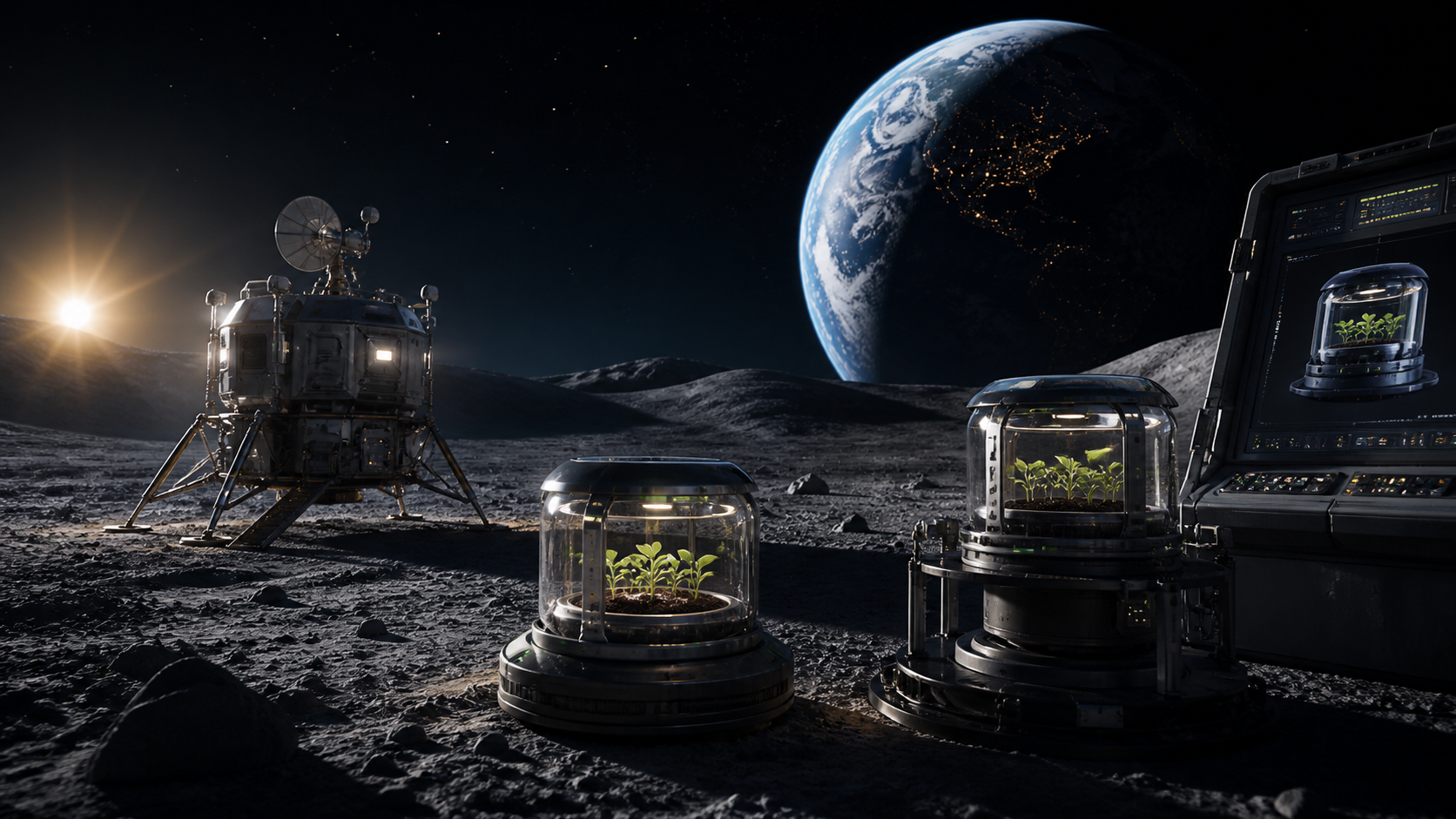
Place seeds from one lot into three sets of identical cultivation units. Let one set grow in the Moon's ambient gravity, about 0.166g. Put a second lunar set on a rotating reference that produces a higher effective acceleration. Run a commanded twin on Earth under the same lighting, temperature, humidity, carbon dioxide, water delivery, nutrients, and schedule. Then follow every seed to edible output.
This is not a miniature lunar farm. It is a controlled precursor with one job: determine whether a replicated uncrewed experiment can distinguish crop responses under sustained actual lunar gravity from responses in a local rotating reference, while measuring the mission exposures that remain mixed with gravity.
NASA has already narrowed the biological search. Christina Johnson and colleagues reported a screen of 60 microgreen species using morphology, yield, viability, organoleptic acceptability, and nutritional value. Eighteen advanced. The same program described ground simulations of microgravity, lunar gravity, Martian gravity, and 1g, along with parabolic-flight work on harvest and bagging operations. That effort identifies candidates and practical procedures. It does not show how an edible crop performs through a sustained cycle on the lunar surface.
The distinction is worth resolving before crew arrival. Random positioning and other simulators can reveal possible gravity responses under controlled ground conditions. Parabolic aircraft can expose people and hardware to brief intervals. Neither reproduces ten to fourteen continuous days of growth under the Moon's field, after launch and transit, with surface radiation, thermal history, power constraints, communication gaps, and autonomous recovery.
A well-designed precursor would use independent cultivation units as replicates. Repeated images from one tray are measurements, not replication. Units should be assigned randomly within mechanical constraints, and tray position and hardware location should remain in the record. That discipline matters because the rotating arm can create gradients, vibration, temperature differences, and position effects that resemble biology if the design is too sparse.
The local rotating comparison is valuable because both lunar arms share launch, transit, surface radiation, communications, and much of their hardware history. It narrows the gravity question. It does not erase the rotor's own acceleration gradient or vibration. The Earth twin answers a different question: how the combined off-Earth history changed the result. It cannot assign a difference separately to launch, transit, radiation, vibration, thermal exposure, or another factor. Three comparisons reduce ambiguity without pretending to eliminate it.
The biological endpoints should extend beyond germination photographs. The payload should measure root and shoot orientation, canopy development, visible stress, crop loss, fresh and dry edible biomass, microbial load, nutrient and selected phytochemical composition, and targeted tissue markers. It should also measure the environment at the plant: acceleration vector and gradient, vibration spectrum, radiation dose, hardware temperature, airflow, gases, light, and root-zone moisture. Without those data, the cabin or device can masquerade as gravity.
The engineering record is equally important. Power, water, consumables, commands, data losses, faults, autonomous recovery, and safe-state events should share timestamps with the crop record. A lunar payload that grows a healthy canopy after constant intervention from Earth has answered a different question from one that detects a blocked line and recovers without help. The first crew will need the second kind of evidence.
Manzano and colleagues provide a useful hypothesis, along with a warning against overreach. Across several four-day experiments, they used four Arabidopsis thaliana lines and conditions that included simulated microgravity, 0.17g, 0.38g, and 1g. Not every line entered every gravity and endpoint comparison. The two simulation paradigms did not agree on every Mars-level endpoint, although the authors' overall interpretation suggested a response transition between lunar and Martian levels. The work concerns one model plant, an early developmental stage, and cellular endpoints. It does not establish a universal threshold for edible production.
That gap defines the precursor's primary measurement. A named crop should complete an edible cycle, preferably across repeated units and, where feasible, more than one gravity dose. Yield must travel with microbial safety, nutrient composition, crop loss, water and power use, and environmental history. A larger mission can follow later. The first payload earns its value by refusing to ask too many questions at once.
The accommodation sheet must be honest before the concept is called near term. Allocated mass, stowed and deployed volume, average and peak power, heat rejection, data volume, command latency, containment, landing survival, surface thermal range, rotor radius and speed, vibration limits, and sample disposition are all still to be established with a delivery provider. The proposed ten-to-fourteen-day campaign is a planning window, not a booked mission duration.
Those unknowns create decision gates rather than blank spaces to be filled optimistically. The payload must demonstrate representative replication, calibrate acceleration and vibration at every unit, survive fault injection, reach a safe state without immediate ground intervention, and complete independent safety and environmental reviews. A primary biological endpoint and a primary engineering endpoint should be frozen before accommodation trades tempt the study to collect many interesting signals without enough power to decide any of them.
Gastronaut is developing ORCA as a ground-stage rotating crop platform at approximately TRL 3 to 4. It has not flown. No environmentally qualified, manifested, or currently available Gastronaut lunar payload exists. The Lunar Crop Precursor Concept is therefore an experiment design for critique, with decision gates for replication, calibration, fault injection, environmental qualification, safety review, and delivery interfaces.
The next credible act is a short NASA technical review among crop, lunar-payload, Human Research Program, food-safety, and systems investigators. Reviewers can challenge the gravity conditions, rotor controls, primary biological and engineering endpoints, and the accommodation fields that must close before anyone makes an availability statement. That conversation would improve the experiment even if the eventual payload looks different.
The Moon will give the field a gravity exposure no simulator can reproduce continuously on Earth. It should not give the first crew an uncontrolled experiment. Send the seeds first, and make their entire journey answerable.
Research foundation and evidence boundaries
NASA's 2022 record supports the 60-species screen, 18 selections, simulated fractional-gravity work, and brief parabolic operations research. Across several four-day experiments, Manzano et al. used four model-plant lines, but not every line entered every gravity and endpoint comparison. The two simulation paradigms diverged on at least one Mars-level result, so the study supports a bounded response-transition hypothesis rather than an edible-production threshold. Gastronaut owns the precursor synthesis and proposed controls. ORCA is ground-stage at approximately TRL 3 to 4 and has not flown. Payload mass, volume, power, thermal, data, containment, qualification, and delivery interfaces remain unresolved planning gates.
References
- Johnson, Christina, et al. Evaluating Microgreens Crop Readiness for Space Production. NASA NTRS, 2022. https://ntrs.nasa.gov/citations/20220016564
- Manzano, Aránzazu, et al. "Novel Moon and Mars Partial-Gravity Simulation Paradigms and Their Effects on the Balance Between Cell Growth and Cell Proliferation During Early Plant Development." npj Microgravity, 2018. https://doi.org/10.1038/s41526-018-0041-4