The Menu Shrinks Before the Ratings Fall
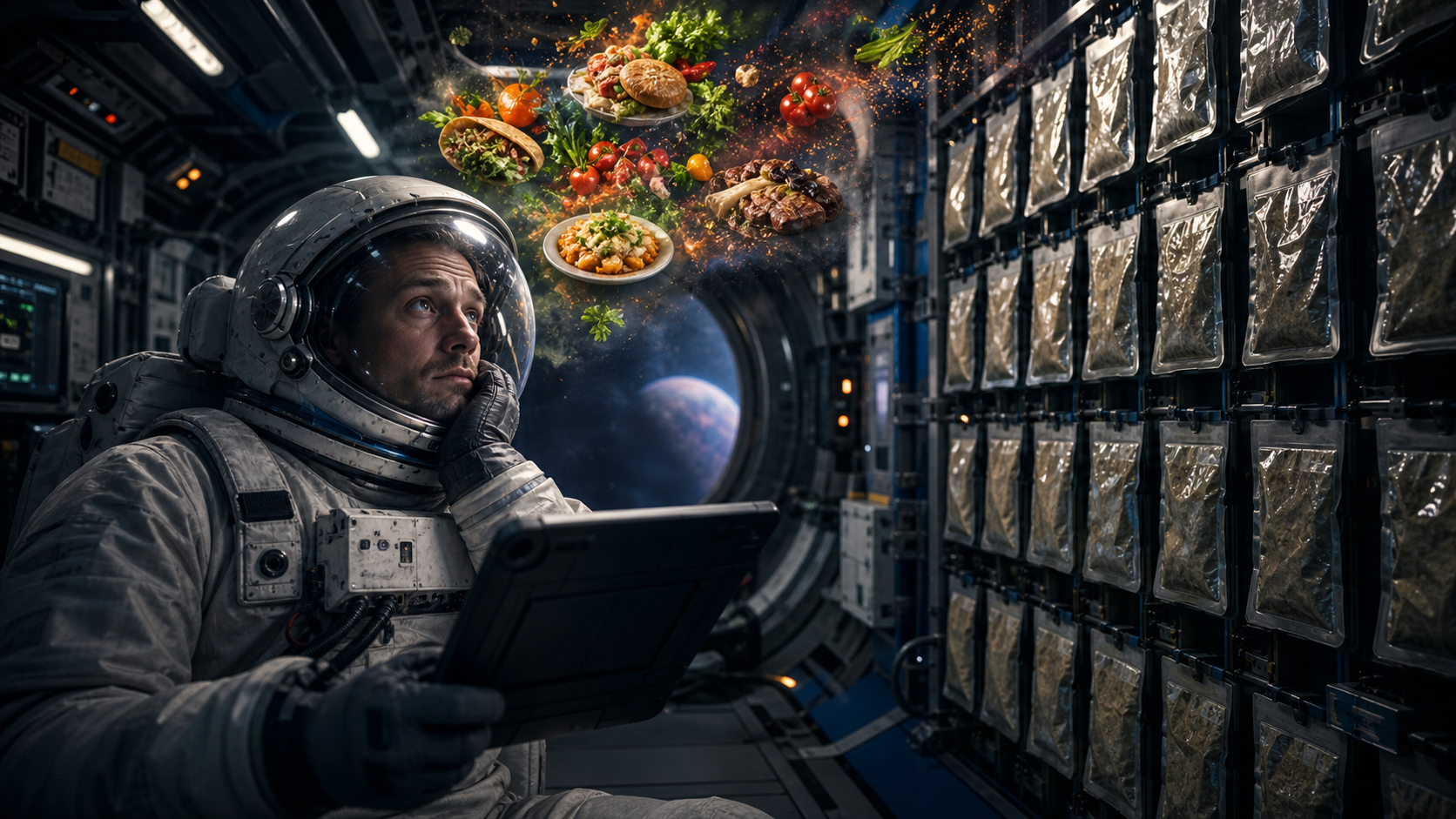
The scorecards looked reassuring. Across 1,772 food ratings from 15 astronauts on International Space Station missions lasting 166 to 355 days, acceptance of the foods they selected did not decline over time. The comments sounded different. Nine astronauts described boredom, cravings, repeated containers, or a need for greater variety. Among those nine, the first signs appeared between one and four months into the mission.
Both results can be true. In fact, their coexistence reveals how menu fatigue may become operationally important before the average rating moves. What matters is not simply whether astronauts still like the foods on their plates. It is whether the set of foods they are willing and able to put there is quietly narrowing.
Grace Douglas and colleagues asked crew members to rate foods and beverages from one meal per week on a nine-point hedonic scale. They also collected open comments and post-mission debriefs. The original hypothesis anticipated that repeated exposure would make individual foods less acceptable. That pattern did not appear. Astronauts identified favorites, selected them again, and continued to score them well.
The stable rating deserves to be believed. It also needs its denominator. A food that leaves an astronaut's rotation produces no later score. The study measures the items that survive personal preference, availability, packaging, and preparation. In statistical terms, the menu is being observed after selection. In ordinary terms, the astronaut can keep liking dinner while becoming tired of everything else.
The 434 rated foods were not experienced as one common menu. Two hundred fifty-four were rated by only one astronaut. That distribution shows how strongly preferences varied across the small cohort. Nine of fifteen crew members still volunteered fatigue indicators even though selected-item scores stayed high. Their experience resembled a shrinking safe harbor: the favorites remained acceptable, but fewer alternatives offered relief from repetition.
This reframes what mission planners should watch. Averages can remain flat while preferred items run low, cravings intensify, condiments carry more work, and a crew member cycles through an ever smaller set. Open comments capture some of that movement, but a lunar food system will need behavioral measures that can detect it prospectively.
The ISS also provides escape valves that exploration missions may not. Crew members can draw from standard foods, personal preference items, international-partner selections, condiments, and occasional fresh deliveries. Lunar food may be positioned before the final crew is known. Resupply can be less frequent. Refrigeration, heavier packaging, and additional variety compete with mass, power, volume, and waste. A menu designed for an average astronaut may fit no actual astronaut particularly well.
Personal preference should therefore enter the protocol before launch, not only after fatigue appears. A baseline can identify the foods, textures, meal types, and condiments each crew member uses to recover variety. In mission, selection breadth can be compared with that individual baseline rather than a crew average. The same method can distinguish a temporary stockout from a sustained contraction in choice. It converts “more variety” from a debrief comment into a change that can be seen while there is still time to respond.
Fresh crops could widen the sensory field through color, aroma, moisture, texture, harvest timing, and participation. That possibility is attractive precisely because stored menus lose novelty. It remains a research proposition. A fresh item has value only if crew members choose and consume it, it displaces or complements the packaged menu in a useful way, and its nutritional and behavioral contribution justifies the production burden.
The measurement standard should therefore carry two signal families. Item-level acceptance includes hedonic score, repeated selection, preparation quality, discarded portions, and consumed mass. System-level behavior includes the number of distinct foods selected, the share of intake coming from a narrow favorite set, stockouts, substitutions, cravings, condiment use, and comments about missing textures or meal types. Neither signal can stand in for the other.
A crop harvest should enter the same ledger. Investigators need harvested mass, edible mass, portion offered, portion consumed, the identity of the packaged food displaced, and menu breadth before and after the serving. Batch composition should connect the behavioral event to nutrient delivery. A short acceptability measure can then be interpreted alongside choice rather than in isolation.
A fair objection is that the ISS study did not show a decline in total intake caused by menu fatigue. Several astronauts anticipated greater difficulty on longer missions or with fewer preference foods, but anticipation is not an observed health outcome. Fresh crops have not been shown to prevent menu fatigue. Gastronaut does not claim that ORCA does so. ORCA is a ground-stage platform at approximately TRL 3 to 4 and has not flown.
NASA can nevertheless act before a clinical consequence appears. The Crop-to-Crew Minimum Dataset provides fields that can join food offered, food consumed, sensory response, appetite, task burden, and mission context. A focused review with NASA food-system and behavioral-health investigators could identify the smallest dual-signal set for a lunar protocol and determine which fields can be captured automatically.
The protocol should also declare what would count as improvement. One additional fresh item may score highly without widening the rest of the menu. A meaningful result could instead be a sustained increase in distinct foods selected, fewer stockout-driven substitutions, maintained energy intake, or lower dependence on a narrow favorite set. The threshold belongs in the study design, before a colorful harvest makes the conclusion feel inevitable.
That standard would also improve technology evaluation. A crop system should earn credit for measured consumption, usable variety, and nutrient contribution, with its crew and resource costs attached. Yield alone cannot show that a menu became more resilient. A favorable rating alone cannot show that the menu remained broad.
The danger does not begin when an astronaut finally gives a favorite meal a low score. It begins when the favorite is one of the few choices left. By then, the menu may have been shrinking for months.
Research foundation and evidence boundaries
The source study followed 15 ISS astronauts on missions lasting 166 to 355 days and collected 1,772 ratings across 434 foods and beverages. Selected-item scores did not decline over time, while 9 of 15 astronauts described fatigue indicators, first appearing between one and four months for those nine. The study did not establish reduced overall intake from menu fatigue. Gastronaut owns the dual-signal measurement synthesis. Fresh crops and ORCA have no demonstrated menu-fatigue prevention effect.
References
- Douglas, Grace L., et al. "Food Acceptability and Selection by Astronauts on International Space Station Missions Informs Strategies and Risks for Deep Space Exploration." Frontiers in Psychology, 2025. https://doi.org/10.3389/fpsyg.2025.1562044