The 0.38g Cliff Is Still a Hypothesis
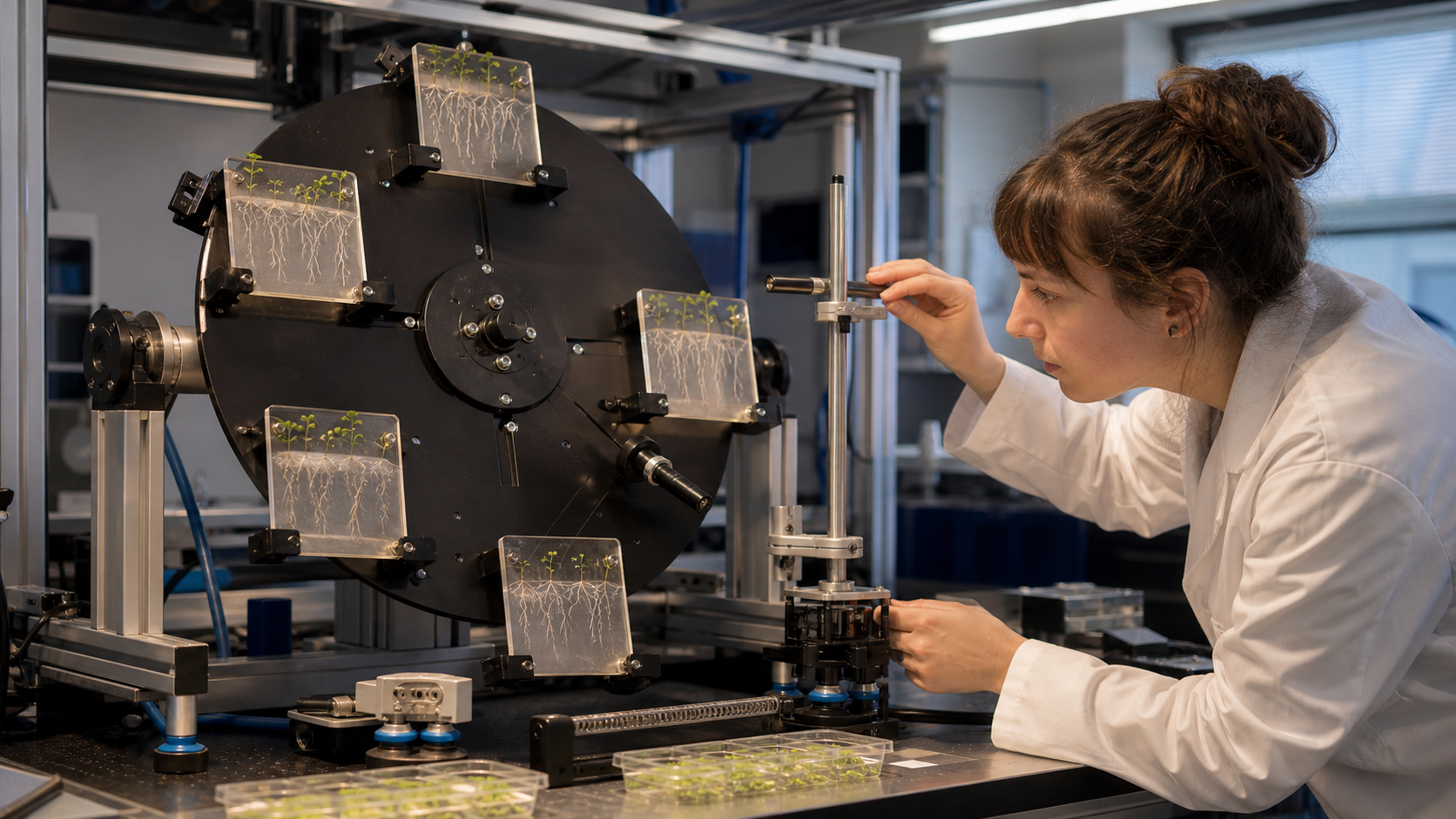
Popular accounts compress the finding into a single sentence, in which plants fail below 0.38g and a lunar farm therefore has to rotate. The experiment behind that sentence fits on a plate. There are 25 Arabidopsis seeds per plate, and four days of plant growth. Measurements were made of early root-meristem biology in the selected simulated gravity conditions.
The study is valuable because it found a difference worth pursuing. The same four-day plate data are a narrow base for a universal cliff. NASA's requirement is more demanding, since it turns on how much gravity is sufficient for which crop, at which stage, in which hardware, and for which production outcome.
Aránzazu Manzano and her colleagues ran their experiments four days at a time, with four Arabidopsis thaliana lines and two random-positioning approaches. Their conditions were simulated microgravity, 0.17g, 0.38g, and a static 1g control. Not every one of those lines entered every gravity and endpoint comparison, however. The measured variables were root-meristem cell proliferation, ribosome biogenesis, and markers of cell-cycle and nucleolar activity.
At the simulated lunar level, the balance between cell growth and cell proliferation shifted relative to the 1g control. In addition, for the reported meristem endpoints, the lunar condition produced greater disturbance than simulated microgravity. The two paradigms also parted at 0.38g. At that level the software paradigm sat closer to 1g for nucleolar size, and the hardware paradigm retained a reduction closer to simulated microgravity. Manzano and colleagues read their combined results as a transition between lunar and Martian levels.
That conclusion rests on one model plant, Arabidopsis thaliana. Four lines of it were used across several experiments, and the data represent early root tissue. Every one of those experiments ran four days, across a sparse set of simulated doses. The plate data say nothing directly about edible yield, nutrient composition, microbial safety, harvest reliability, actual consumption, or a complete crop cycle. They do not show that static plants stop growing below 0.38g. The word “threshold” carries the species, endpoint, duration, and exposure method of this experiment, and it loses its defensibility once those are detached from it.
Simulation adds a further boundary to those plates, because random positioning changes the direction of the gravity vector over time. The device can also introduce rotation, shear, vibration, and other artifacts. A plant on the lunar surface will experience sustained actual partial gravity along with water behavior, radiation, temperature, and hardware conditions that a terrestrial simulator cannot fully reproduce. A simulator therefore generates hypotheses about that environment rather than inheriting its authority.
None of these limits diminishes the experiment. Read this way, the Manzano result works less as a validated finding than as a design brief. A next program built on that brief samples several gravity doses, extends from early mechanism to full-cycle production, and repeats the work across species and cultivars. Root organization is one endpoint in that program, alongside germination, water delivery, gas exchange, canopy development, edible biomass, nutrient stability, crop loss, microbial load, and reproduction.
Rotation remains important because it creates a controllable gravity variable. In low Earth orbit, a centrifuge can place fractional-gravity and 1g references inside much of the same mission environment. On the Moon, a rotating unit can create accelerations above the ambient 0.166g, while a static unit remains in the actual lunar field. Variable speed can turn a binary comparison into a response curve.
The centrifuge is not a free control. Its radius and speed create acceleration gradients across roots and canopy. Its moving parts add vibration, power, thermal load, control complexity, and maintenance. Water and roots inside the rotor experience that geometry along with the nominal gravity dose. Measuring those effects at each cultivation location keeps the device from becoming the strongest unreported treatment in the experiment.
Architecture analysis enters the same chain under a different label in the work of van Loon and colleagues, who describe potential benefits of a continuously rotating partial-gravity spacecraft for physiology, engineering, operations, life support, and safety. Their analysis can guide system trades. It is not a crop experiment, and it does not demonstrate seed-to-seed production under rotation.
Physical plausibility of that kind gives NASA a reason to test, not a biological result.
The practical bridge runs through NASA's microgreens program, in which Johnson and colleagues screened 60 species, selected 18, and described simulated partial-gravity and parabolic-flight work. Those 18 candidates can enter a common gravity-dose matrix. A matrix that retains crop identity, hardware, environmental controls, early mechanism, edible output, safety, resources, and uncertainty turns “sufficient gravity” into an explicit production decision rather than a borrowed phrase.
Three evidence layers converge in that matrix, and each carries its own work. Mechanistic work covers how cells, roots, water transport, and gas exchange respond across doses. Production work carries edible crops through complete cycles and measures yield, quality, safety, and resource use. Environment validation compares simulation with sustained actual partial gravity using matched hardware and controls. A result that reaches only one of the three layers carries evidentiary weight at that layer alone.
The matrix also carries an explicit decision rule, because a gravity condition might preserve root organization yet lose too much edible yield, demand too much water, or destabilize microbial control. Another condition might improve production while making the rotor's power and maintenance burden unacceptable. “Enough gravity” is therefore a systems threshold, not simply a cellular one, and NASA should define the minimum acceptable crop outcome and the maximum resource cost before selecting the operating point.
Gastronaut is developing ORCA as a rotating ground-stage crop platform at approximately TRL 3 to 4. It has not flown. The Manzano study informs its experimental questions, but it does not validate an ORCA operating range or establish ORCA crop performance on the Moon. The Lunar Crop Precursor Concept makes the proposed gravity conditions, rotor confounds, environmental measurements, and validation gates available for review.
Specialists in plant gravity, crop production, and lunar systems at NASA can examine that matrix before hardware choices harden. Their review would cover which species and endpoints take the first doses, which gradients and vibration measurements make the rotor interpretable, and what result would justify a later sustained lunar test. Answers on those three points would turn one suggestive experiment into a research sequence.
The four-day plate revealed no cliff at 0.38g, and it showed instead where the map becomes blank.
Named crops carried across that blank space, through full cycles and measured harvests, are what would let a gravity dose be reported as a yield figure rather than a slogan.
Research foundation and evidence boundaries
Manzano et al. ran several four-day experiments with four Arabidopsis lines, 25 seeds per plate, under conditions that included simulated microgravity, 0.17g, 0.38g, and 1g. Not every one of those lines entered every gravity and endpoint comparison. At the Mars level, the two simulation paradigms diverged for at least one nucleolar-size result, though Manzano and colleagues read their combined results as a transition between lunar and Martian levels. The study supports a bounded response hypothesis, not a universal crop threshold. Van Loon et al. provide architecture analysis rather than crop-performance evidence. ORCA is ground-stage, approximately TRL 3 to 4, and has not flown.
References
- Manzano, Aránzazu, et al. "Novel Moon and Mars Partial-Gravity Simulation Paradigms and Their Effects on the Balance Between Cell Growth and Cell Proliferation During Early Plant Development." npj Microgravity, 2018. https://doi.org/10.1038/s41526-018-0041-4
- van Loon, Jack J. W. A., et al. "Benefits of a Rotating Partial-Gravity Spacecraft." Acta Astronautica, 2024. https://doi.org/10.1016/j.actaastro.2024.04.041
- Johnson, Christina, et al. Evaluating Microgreens Crop Readiness for Space Production. NASA NTRS, 2022. https://ntrs.nasa.gov/citations/20220016564