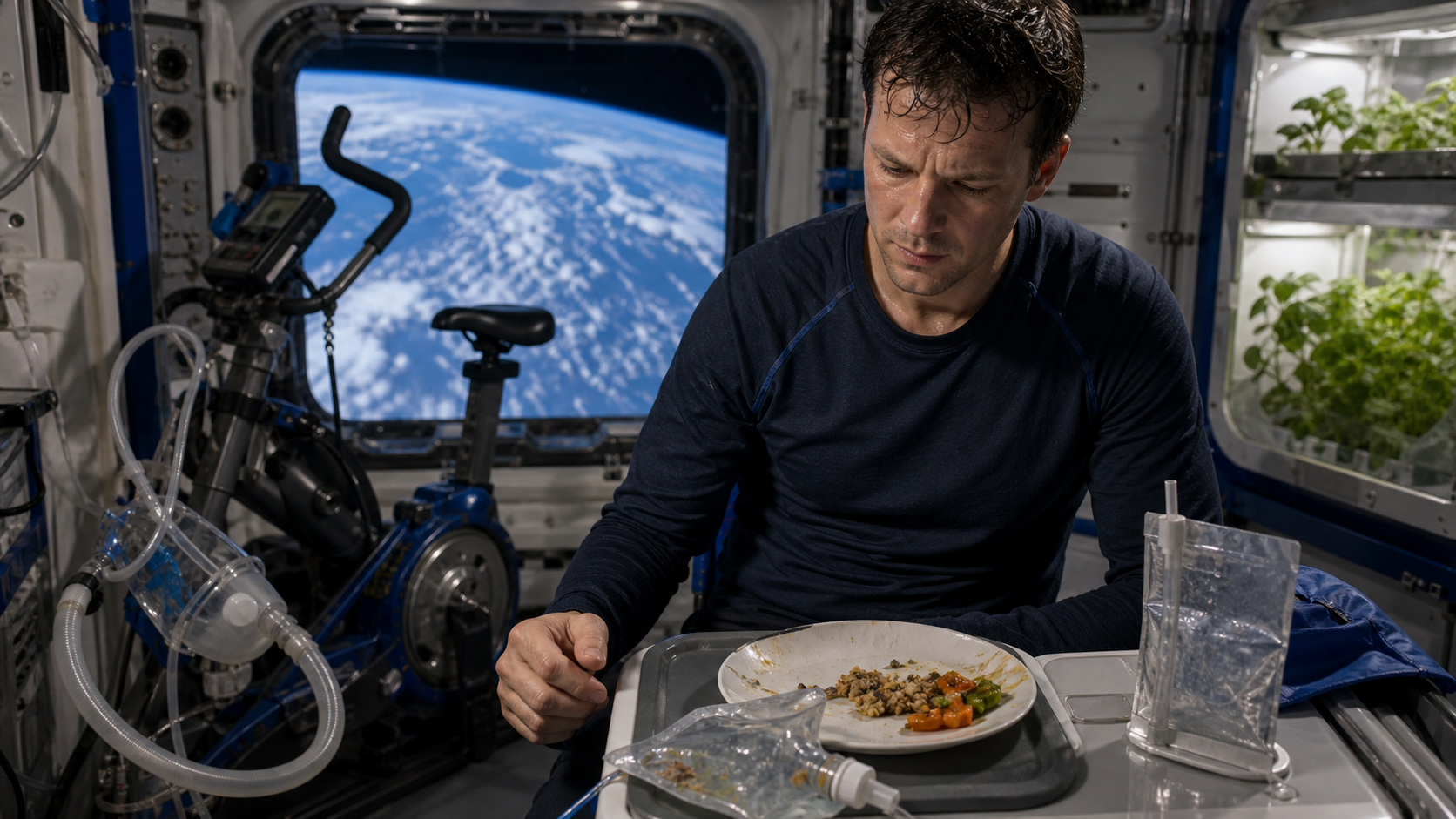
The Missing Variable on the Plate
Eight astronauts sat down to meals aboard Spacelab D2, Euromir 94, and Euromir 95, and beneath nearly every physiological result recorded on those missions, one variable kept moving. In most of the eight, measured energy intake ran more than 20 percent below calculated expenditure. The food itself was logged, and the missions were completed without incident. But the dietary background against which bone, muscle, and metabolism were later interpreted was never actually stable.
That is not a claim that every astronaut under-eats by some fixed amount. The cohort was small, the missions differed from one another, and the tools used to measure intake have changed over time. What it does establish is more useful for how research gets designed: energy balance behaves as an exposure, not as scenery sitting in the background. When intake drops while microgravity, exercise load, sleep, stress, and workload are all shifting too, a biomarker measured later cannot be pinned cleanly on any single one of them.
That creates a governing question for any food-based countermeasure a study proposes. Did the intervention actually change the outcome, or did the crew member's total energy state change the conditions under which the intervention was being tested in the first place? A study that does not trace the meal from food offered to food actually consumed, and then place that dose inside the full picture of intake and expenditure, cannot answer the question with any confidence.
Evidence spanning several mission eras shows why this question can't simply wait for a later study. In the European missions reported by Heer, most of the eight astronauts consumed over 20 percent less energy than their calculated expenditure required, and average calcium intake sat 25 percent below the cited terrestrial recommendation. The paper itself focused on bone turnover, but the lesson for study design reaches further than that one endpoint. A calcium-related result observed against an unstable energy background isn't purely a calcium result anymore.
On the International Space Station, Smith and colleagues followed 11 crew members across missions running 128 to 195 days. Mean intake came in around 80 percent of the recommended energy level, body weight was lower at landing than at launch, and several nutritional and oxidative-status measures shifted along the way. Because the study was observational, it couldn't cleanly divide those changes among energy deficit, microgravity, exercise, mission stress, or the interactions between them. What it did establish, though, is that intake was never a fixed control condition to begin with.
A larger retrospective view makes the pattern harder to wave off as one mission's artifact. Matsumoto and colleagues analyzed 514 mission records drawn from 246 astronauts. Mean weight change came out to minus 2.1 percent, and mission duration tracked with roughly minus 2.4 percent per 100 days. Severe space motion sickness was linked to greater weight loss, and other personal and mission-specific variables mattered as well. Body weight is an imperfect stand-in for energy balance, granted. Still, 514 records is enough to show that in-flight loss happens often enough to design around from the start, rather than explain away after the fact.
The biochemical stakes show up clearly in six Mir crew members studied by Stein and colleagues. Mean intake fell from 2,854 to 2,145 kilocalories per day over the course of the mission. Whole-body protein synthesis dropped from 226 to 97 grams per day, and the change in synthesis tracked the change in intake with an r-squared value of 0.86. None of that should be read as a universal mission constant. It is, instead, a warning that a metabolic shift of real magnitude can follow directly from the calories that go missing off the plate.
These four studies shouldn't get pooled into a single grand deficit rate; their cohorts, platforms, eras, endpoints, and methods all differ too much for that. Where they do agree is at a different level entirely. Energy shortfall recurs. It varies by person and by mission. And it can alter the underlying biology that a nutrition study is trying to interpret in the first place. Treat it as a covariate added after the fact, and you risk asking the right health question with the wrong denominator underneath it.
Take a crop-derived nutrient tested during a lunar mission as an example. If an oxidative-stress marker improves less than expected, the easy conclusion is that the nutrient failed. But the crew member might also have consumed too little of the crop, too little total food, or too little energy overall to sustain the pathway being measured in the first place. The reverse holds too: a marker could move simply because lower intake changes substrate flow, with the crop's actual mechanism having nothing to do with it. Without the full dietary picture, even the direction of the story can come out wrong.
This is exactly why biomass sits several steps removed from being a countermeasure. A cultivation unit can produce right on schedule, the harvest can clear safety review, and a portion can make it to the tray, and none of that establishes dose. The crew member might eat half of it, discard the rest, or trade it for a different nutrient source entirely. Composition can vary by crop lot. A daily energy deficit can simply overwhelm whatever nutritional contribution was intended. Food available, food served, food consumed, and nutrition actually delivered are four separate records, not one.
NASA's June 2026 Food and Nutrition Risk Approach Plan identifies the use of food as a countermeasure under gap FN-206, and that framing raises the bar in a genuinely useful direction. A study built to that standard would record intervention dose, total energy intake, expenditure, body composition, and a time-resolved health or performance endpoint, all under one analysis plan. Depending on mission constraints, doubly labeled water, weighed food records, image-assisted intake capture, body-composition measurement, and metabolite assays can each carry part of that burden. No single tool has to do everything, but the chain from food to outcome can't have an invisible middle.
The most efficient way to get there may start on the ground. A matched campaign could test identical crop lots, portions, assays, time points, and endpoints under both energy-balanced intake and a representative deficit range. A smaller flight study could then carry that protocol forward and test what the ground campaign simply cannot reproduce. Ground work would define the interaction and cut down uncertainty considerably. What it would not do is become flight evidence just by being repeated enough times.
Gastronaut has built that logic into its Crop-to-Crew Minimum Dataset. The proposed record connects edible yield and batch chemistry to portion offered, portion consumed, total daily diet, expenditure, body composition, and acute response, all in one chain. Gastronaut is seeking a focused technical review with NASA Human Health Countermeasures and food-system researchers to decide the smallest plate-to-endpoint chain that a future protocol should actually require. No joint study is claimed here, and no present ORCA human effect is either.
When a crew biomarker changes, the first question shouldn't be whether the food was aboard the spacecraft. It should be what was actually eaten, against what energy demand, and with what result. A countermeasure only really begins at the plate once the plate stays connected to the person eating from it.
Research foundation and evidence boundaries
The astronaut findings above come from the cited peer-reviewed cohorts. Gastronaut owns the cross-study synthesis and the proposed measurement architecture built on top of them. The cohorts differ from one another and do not establish a single universal deficit rate; body weight is not a complete measure of energy balance, and observational evidence cannot assign causation to any one exposure. ORCA remains a ground-stage system at TRL 3 to 4, has not flown, and has no demonstrated human-health effect.
References
- Heer, "Nutritional interventions related to bone turnover in European space missions and simulation models," Nutrition, 2002. https://doi.org/10.1016/S0899-9007(02)00905-X
- Smith et al., "The nutritional status of astronauts is altered after long-term space flight aboard the International Space Station," Journal of Nutrition, 2005. https://doi.org/10.1093/jn/135.3.437
- Matsumoto et al., "Weight loss in humans in space," Aviation, Space, and Environmental Medicine, 2011. https://doi.org/10.3357/ASEM.2792.2011
- Stein et al., "Protein kinetics during and after long-duration spaceflight on MIR," American Journal of Physiology-Endocrinology and Metabolism, 1999. https://doi.org/10.1152/ajpendo.1999.276.6.E1014
- NASA Human Research Program, "Research Approach Plans, June 2026," Food and Nutrition Risk Approach Plan. https://www.nasa.gov/wp-content/uploads/2026/06/hrp-rap-for-web-62026.pdf
- Gastronaut, Crop-to-Crew Minimum Dataset, August 23, 2026.