The Analog Pointed the Wrong Way
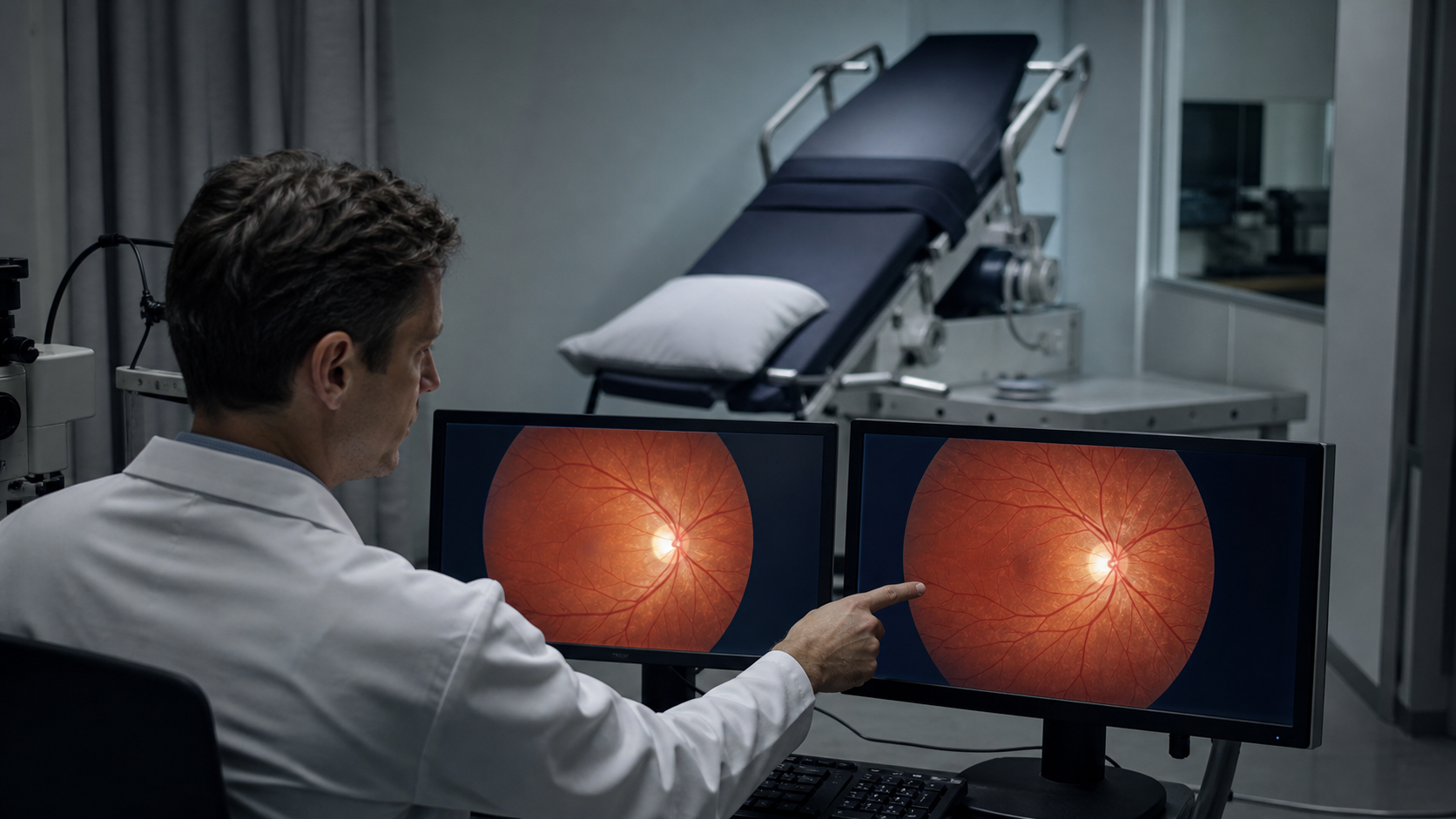
Two sets of retinal images told opposite stories. After roughly six months in space, vascular density decreased in images from astronauts. After 70 days of six-degree head-down tilt bed rest, it rose slightly. The analog did not simply produce a smaller version of the flight signal. For the measured endpoint, it pointed the other way.
Taibbi and colleagues made the comparison with NASA's VESsel GENeration Analysis software. The flight cohort included eight astronauts and 16 retinas. The bed-rest cohort included five participants and 10 retinas. One retina from an astronaut with a spaceflight-associated neuro-ocular syndrome diagnosis showed the greatest vascular loss. The ground increase had limited significance, but the disagreement in direction remained the finding that demands attention.
The governing question is not whether head-down tilt is a good or bad analog. It is whether a specific analog predicts a specific endpoint well enough to support a decision. That is a harder standard, and a more useful one, than calling a model valid in general.
Head-down tilt earns its place in spaceflight research. It produces controlled unloading and headward fluid redistribution. Investigators can recruit participants, standardize meals and sleep, take repeated measurements, and test interventions without using scarce flight resources. Those advantages make it excellent for questions it can represent. They do not turn a tilted person under Earth gravity into a smaller spacecraft.
An astronaut experiences sustained weightlessness alongside radiation, altered atmospheric conditions, exercise countermeasures, constrained food choices, changing sleep, operational stress, and months of adaptation. A bed-rest participant reproduces selected components of that exposure. If headward fluid shift were sufficient to predict the retinal vascular-density response, agreement in direction would have been reassuring. Its absence tells researchers that the bridge between mechanism and endpoint needs inspection.
The strongest skeptical reading deserves equal weight. These cohorts were small and unequal. Their exposures lasted different lengths of time. The available retinal image fields differed between groups, and measurements did not form a continuous biological record. Only one sampled astronaut retina carried a SANS diagnosis. The slight increase after bed rest had limited significance. Those constraints prevent a general estimate of how inaccurate the analog was, and they do not identify a single missing mechanism.
They also do not erase the reversal. A weak ground increase and a significant flight decrease cannot be compressed into a story of successful directional prediction. The result should instead change how confidence is assigned. The analog may remain valuable for fluid-shift studies while carrying lower evidentiary weight for this retinal endpoint until the discrepancy is understood.
That lesson reaches beyond ocular research. Space programs depend on ground models because flight opportunities are scarce, expensive, and slow. Crop studies use random-positioning machines. Nutrition studies use cells, rodents, confinement, and bed rest. Radiation studies use selected beams and dose schedules. Each model isolates a tractable part of the mission environment. Each can become misleading if the isolated mechanism is allowed to stand in for the outcome that matters.
For Gastronaut, the implication is direct. A ground cultivation archive can show operating repeatability, reveal failure modes, compare candidate conditions, and prepare a protocol. It cannot establish that crop biology, nutrient composition, crew intake, or a health response will behave the same way in flight. Increasing the number of ground cycles strengthens the answers the ground system can provide. It does not measure the exposure that remains absent.
The corrective is to design the transfer bridge before the first favorable result appears. A paired program should use the same primary endpoint, instrument, field definition, sampling interval, and analysis code in the analog and flight-relevant setting. It should state which exposure the analog reproduces, which it omits, what direction is expected, and how much transfer error is acceptable for the intended decision. A directional reversal should trigger a mechanism review, not a rhetorical adjustment.
That information belongs in a calibration record beside the result. Each entry would name the model, intended flight exposure, endpoint, expected direction, observed direction, duration, known omissions, and decision threshold. A screening analog could then earn high confidence for one outcome and low confidence for another without being defended or rejected as a whole. Over time, NASA would gain a map of where each model transfers, where it attenuates, and where it reverses. The record would make an analog portfolio easier to improve because disagreement would become data.
Negative transfer results should also remain visible. If an analog predicts germination but not composition, that boundary is useful. If a nutrient marker transfers but a functional endpoint does not, the distinction guides the next study. If a model predicts the wrong direction, preserving that contradiction can prevent a screening tool from becoming an unjustified selection rule.
NASA can apply this standard without discarding the practical value of analogs. Human Health Countermeasures and space-biology teams could select one crop or nutrition endpoint and carry the same samples, instruments, fields, timing, and thresholds from a controlled ground campaign into a later flight study. The ground phase would narrow candidates and characterize variance. Flight would test the transfer claim. The Crop-to-Crew Minimum Dataset offers a proposed set of linked identifiers and measurements for that bridge.
The two retinal image sets should not be remembered as a verdict against bed rest. They should be remembered as a calibration mark. An analog earns confidence one endpoint at a time, and sometimes the most valuable arrow on the map is the one pointing the wrong way.
Research foundation and evidence boundaries
The comparative retinal findings come from the cited peer-reviewed study. Gastronaut owns the broader methodological synthesis and proposed application to crop and nutrition research. Small cohorts, unequal duration and image fields, limited ground significance, and one SANS-associated retina prevent a general estimate of analog accuracy. The study does not invalidate head-down tilt or identify one causal mechanism. Gastronaut ground records are not evidence of a flight biological effect.
References
- Taibbi et al., "Opposite response of blood vessels in the retina to 6° head-down tilt and long-duration microgravity," npj Microgravity, 2021. https://doi.org/10.1038/s41526-021-00165-5
- Gastronaut, Crop-to-Crew Minimum Dataset, August 23, 2026.