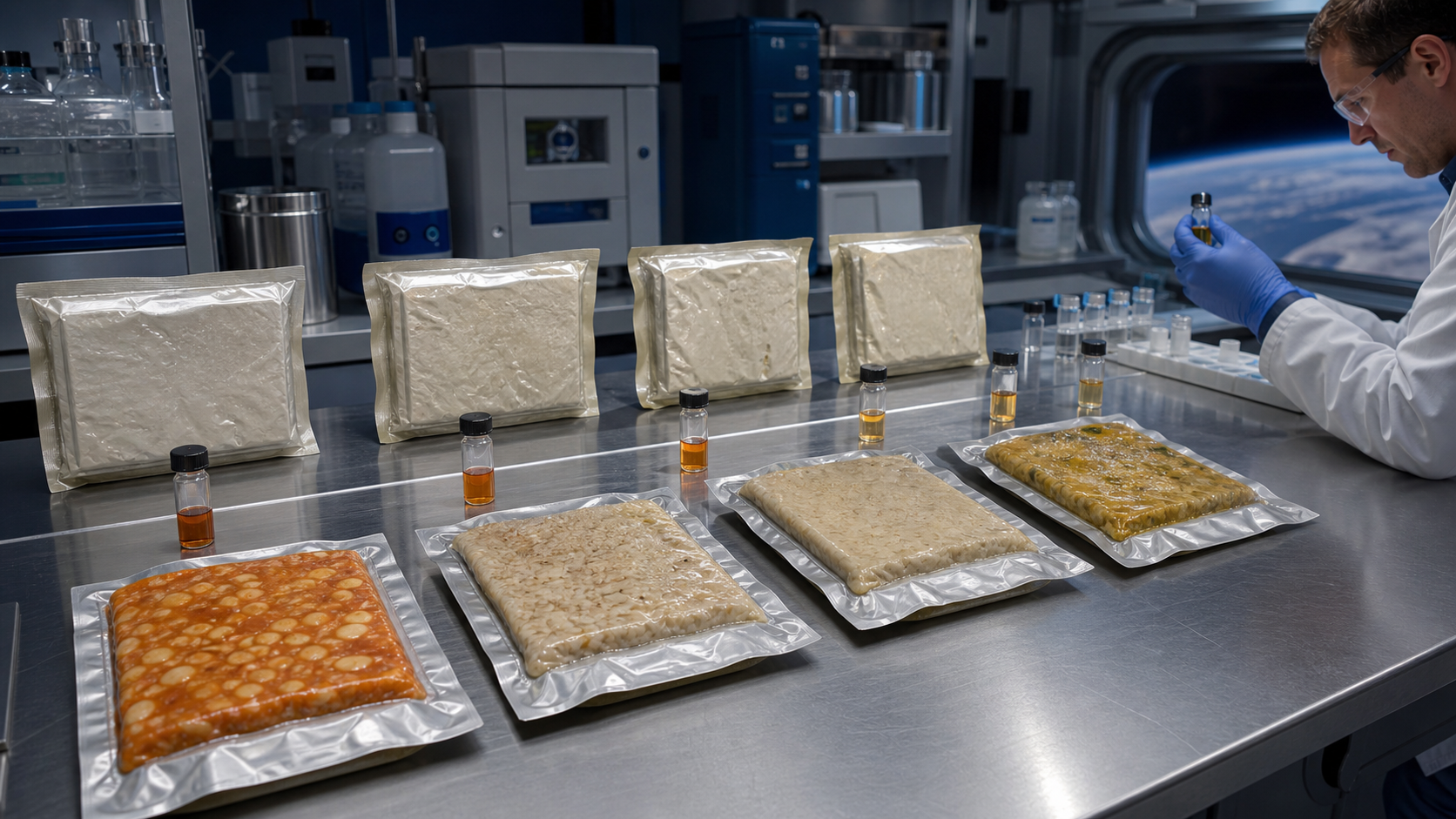
Four Food Kits and a Clock
Four identical food kits left Earth, but they did not come home together. One returned after 13 days. The others waited 353, 596, and 880 days aboard the International Space Station. Each held five foods, a multivitamin, and vitamin D. While the flight kits aged in orbit, same-lot controls aged in an environmental chamber on Earth.
The staggered returns turned storage into a clock. For every flight item at every time point, researchers tested six replicates; the corresponding ground comparison used nine. They measured intact vitamins, amino acids, oxygen radical absorbance capacity, and hexanal as an indicator of lipid oxidation. After 596 days, storage duration was associated with differences in intact-vitamin concentrations in most of the foods. Yet the flight samples generally did not degrade faster than their matched ground controls.
That is not the familiar space-food story. It does not say orbit is irrelevant, or that every nutrient survives. It says the decisive exposure in this matched study was often time itself. Before a decline is attributed to "space," the ordinary chemistry of storage must be allowed to answer first.
The design accomplished this by separating two conditions that are usually bundled together. A food returned from orbit has both aged and flown. Without a same-lot ground control exposed over the same period, packaging, oxygen, temperature history, and food matrix can be mistaken for a flight effect. The matched controls did not eliminate uncertainty, but they gave the investigation a credible way to allocate it.
The boundary of the result matters as much as the result. Five foods and two supplements do not represent an exploration menu. ISS storage does not reproduce every temperature excursion, radiation environment, packaging constraint, or mission duration that a Mars system would face. The samples returned for laboratory analysis, a luxury a crew moving away from Earth will not have. The paper also does not support one universal vitamin C decay rate across foods. Item, matrix, assay, package, and time remain part of any defensible number.
Still, the experiment supplies a rare flight-exposed baseline. It changes the next question from "Does space destroy nutrients?" to "Which nutrients fail first, in which food matrices, under which storage histories?" That formulation is less dramatic and more useful. It points directly toward temperature logging, package chemistry, repeated assays, and uncertainty tied to the meal rather than the mission label.
Fresh production is often offered as the answer to long storage. It may be part of the answer. A crop can replenish compounds that prove difficult to preserve and can add color, texture, aroma, and variety. But a harvest starts a second clock. Cultivar, light, atmosphere, root-zone conditions, harvest age, handling, and delay before consumption can change composition. The edible mass may vary. Some of the portion may never be eaten.
Fresh therefore does not automatically mean more nutrition delivered, just as stored does not automatically mean nutritionally inadequate. Growing food adds power, water management, microbial monitoring, cleaning, crew time, and failure recovery. Stored food carries packaging, logistics, menu, temperature, and shelf-life burdens. The proper comparison is not plant against pouch. It is the nutritional contribution actually consumed from each system, measured over the same mission interval and charged against the resources required to deliver it.
That comparison could produce a mixed architecture. Shelf-stable foods may continue to provide most calories and menu structure. Refrigeration, improved packaging, or formulation may protect selected items. Compact crop production may replenish a small set of nutrients or sensory experiences where the marginal value is greatest. The winning mix could change with mission length. A short lunar stay and a Mars transit should not inherit the same answer merely because both occur beyond low Earth orbit.
NASA's Moon-to-Mars Architecture Definition Document places preservation and storage, food production, and Earth-independent intake tracking under Gap 0305. The June 2026 Food and Nutrition Risk Approach Plan identifies temperature effects on content, safety, and acceptability in FN-103. Together, these documents imply a shared experiment: put stored and grown foods on one timeline, assay the same target nutrients in edible portions, record what the crew consumes, and connect that delivery to a predefined health or performance outcome.
The middle of that chain is where studies most easily separate. Chemistry may be excellent while portion records are missing. Crop yield may be precise while batch nutrient content is not. Intake may be known while power, water, waste, and labor remain outside the comparison. A result that skips those links cannot explain why a promising nutrient did or did not reach the crew.
Gastronaut has prepared a Crop-to-Crew Minimum Dataset and Crop-System Resource Accounting Template to make those links inspectable. Gastronaut seeks review from NASA food-laboratory and crop-production researchers on one matched stored-versus-grown protocol using the same mission clock, nutrient assays, edible-portion units, intake record, and resource boundary. ORCA would enter such work only as a ground-stage research platform. It has not flown, and no flight demonstration or crew-health outcome is represented here.
The four kits did more than carry food for different lengths of time. They showed that a mission system needs two clocks: one for what storage removes, and one for what production can reliably replace. The architecture becomes credible when both clocks measure nutrition that reaches the crew.
Research foundation and evidence boundaries
The storage findings come from the cited peer-reviewed ISS study. Gastronaut owns the mixed-system synthesis and proposed linked templates. The study covered selected foods, supplements, assays, and ISS conditions; it does not establish that flight never affects food, predict Mars storage, or support a universal vitamin-specific loss rate. Fresh-production benefits and costs remain questions for matched measurement.
References
- Zwart et al., "Assessment of nutrient stability in foods from the space food system after long-duration spaceflight on the ISS," Journal of Food Science, 2009. https://doi.org/10.1111/j.1750-3841.2009.01265.x
- NASA, "Moon to Mars Architecture Definition Document, Revision C," Gap 0305 and child gaps 0305-03 through 0305-05. https://ntrs.nasa.gov/citations/20250010956
- NASA Human Research Program, "Research Approach Plans, June 2026," Food and Nutrition Risk Approach Plan. https://www.nasa.gov/wp-content/uploads/2026/06/hrp-rap-for-web-62026.pdf
- Gastronaut, Crop-to-Crew Minimum Dataset, August 23, 2026.
- Gastronaut, Crop-System Resource Accounting Template, August 23, 2026.