Wolffia Is Not One Crop
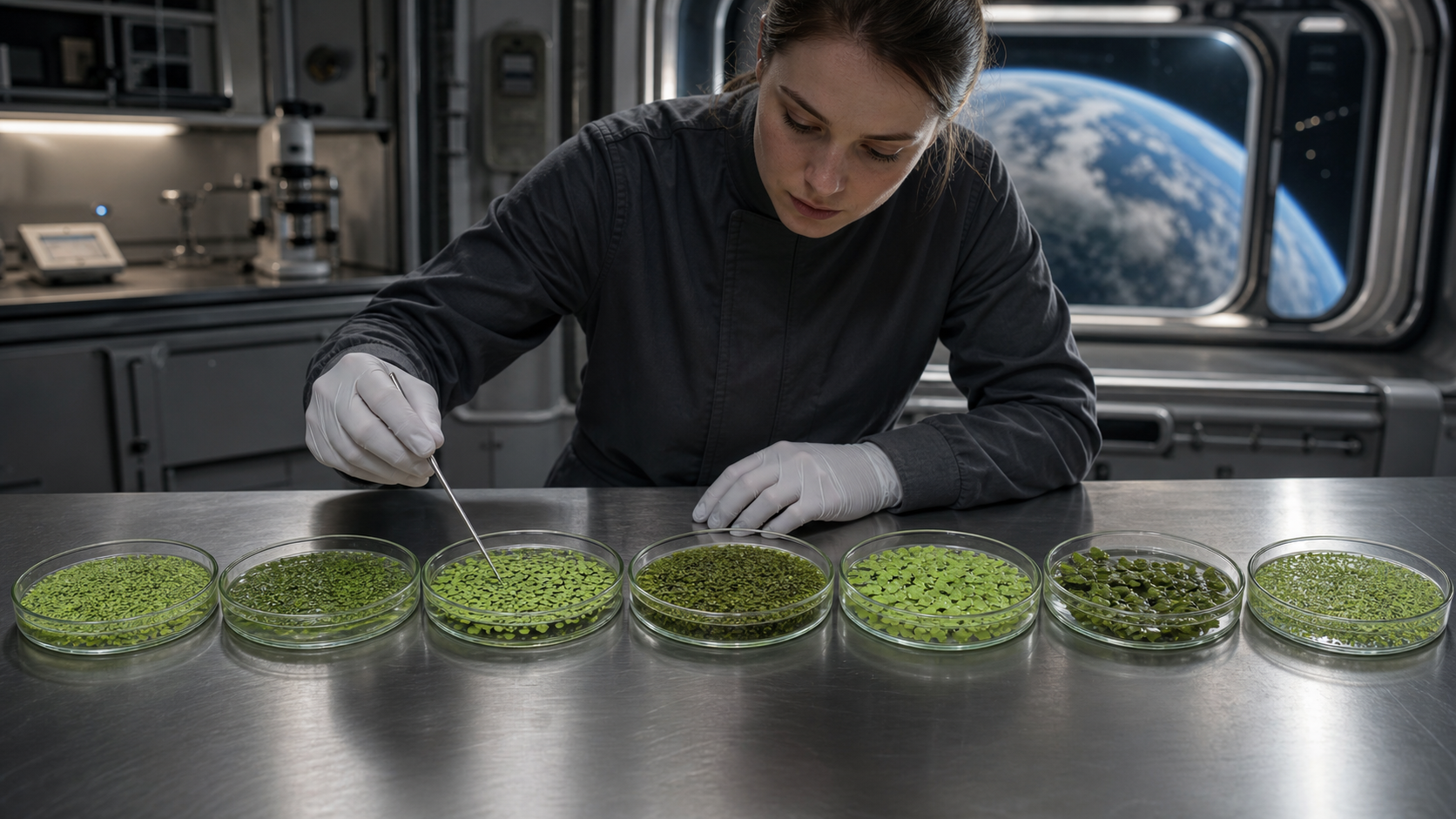
Seven clones of the world's smallest flowering plant entered the same gravity study and refused to behave as one crop. Some grew more slowly under simulated microgravity. Across the set, 4g generally increased relative growth. Protein content generally decreased under simulated microgravity. Even their physical size and growth rate did not move as a single package.
Romano and colleagues compared seven Wolffia globosa clones using a random positioning machine, a 4g hypergravity treatment, and separate 1g controls. They measured relative growth, plant dimensions, morphology, and protein. The experiment was not a lunar farming demonstration. It was something more immediately valuable: a warning against treating a species name as a mission specification.
That makes the selection problem more exact. Which clone can deliver a defined edible output under a defined cultivation environment, and what must the system spend to produce it? Until that question is answered, "Wolffia" is a category, not a candidate.
Its attraction is understandable. Wolffia is tiny, floats, propagates vegetatively, and can generate edible biomass quickly under terrestrial cultivation. Compact form matters when growth volume is expensive. Rapid turnover matters when a study has limited time. Protein matters in a food architecture trying to reduce dependence on a long logistics chain. Those advantages make the plant worth testing. They do not tell NASA which biological material to use.
The seven-clone result shows why selection must occur below the species level. A clone that grows quickly may be smaller, easier to contain, or harder to harvest. Another may retain more protein but demand a longer cycle. A third may tolerate cultivation stress while creating greater processing loss. If a study records only the species, those tradeoffs vanish into an average that no actual crop possesses.
Provenance is therefore not clerical detail. Two laboratories can report Wolffia globosa and still test materially different organisms, inoculum histories, nutrient regimes, light exposures, vessel geometries, and harvest intervals. A clone identifier should travel with the experiment much like a hardware configuration. Without it, replication can fail before the first environmental difference is considered.
The gravity treatments also need disciplined interpretation. A random positioning machine repeatedly changes the organism's orientation relative to gravity. It does not reproduce the full fluid behavior, gas transfer, radiation, vibration, or operations of flight. The 4g arm tested hypergravity, not lunar or Martian partial gravity. Separate 1g controls make the comparisons useful for ground screening. They do not establish how any clone performs in orbit or on the Moon.
The protein result is particularly instructive because it resists the easy sales story. Faster biomass production does not guarantee more useful protein. Percentage protein can fall while wet mass rises. Harvest and processing can remove part of the crop. Digestibility, amino-acid profile, safety, preparation, and acceptance determine whether measured protein reaches a person. A mission does not consume a laboratory percentage. A crew member consumes a portion.
That changes the denominator. A credible comparison should measure digestible protein actually consumed per unit of water, power, growth volume, thermal load, sanitation, harvest effort, and crew time. It should count failed cultures and contamination recovery. A slightly slower clone may win if it retains composition, separates cleanly from the growth medium, and survives repeated harvest. A fast clone can lose its apparent advantage at the screen, the pump, or the plate.
Wolffia's aquatic form adds a productive set of engineering questions. Altered buoyancy and sedimentation can change fluid distribution and gas exchange. Small fronds may migrate through pumps or screens. Dense cultures can shade themselves. Vegetative propagation may carry contamination from one cycle into the next. None of these issues disqualifies the crop. Each is a variable that a compact research campaign can measure before the mission architecture depends on an answer.
A useful progression would begin with clone-level growth, dry mass, protein quantity, amino-acid profile, and digestibility under hardware-controlled conditions. It would then add harvest separation, microbial challenge and recovery, water and nutrient balance, power, processing, crew burden, and sensory acceptance. Relevant partial-gravity settings would follow, with measured acceleration and matched controls. A later flight exposure would test the transfer that ground equipment cannot establish.
The National Academies' 2023 decadal survey identifies secondary protein production as one possible module in a bioregenerative life-support research campaign. NASA's Moon-to-Mars architecture places food production under Gap 0305-05. Wolffia could serve those priorities as a discriminating organism, not as a foregone solution. The valuable result may be the clone that fails cleanly enough to expose which resource or biological threshold governs selection.
For Gastronaut, Wolffia remains a roadmap crop only. It is not part of the current edited-line claim set, and Gastronaut represents no present ORCA Wolffia cultivation, editing, or flight capability. ORCA is a ground-stage platform at TRL 3 to 4 and has not flown. Gastronaut's Crop Readiness Self-Assessment is available for NASA plant and food researchers to critique the evidence fields a future clone-screening program should require.
Seven clones entered the study under one species label. They came out as seven design choices. A mission designer should see seven candidates, then select the one whose delivered nutrition, reliability, and system burden agree.
Research foundation and evidence boundaries
The clone responses come from the cited peer-reviewed ground study. Gastronaut owns the mission-design synthesis and proposed screening sequence. Random positioning and 4g are ground exposures, not lunar, Martian, or orbital validation. Percentage protein is not protein consumed. Wolffia remains a candidate roadmap crop with no present Gastronaut cultivation, edited-line, human-effect, or flight result.
References
- Romano, van Loon, Vincent-Bonnieu, and Aronne, "Wolffia globosa, a novel crop species for protein production in space agriculture," Scientific Reports, 2024. https://doi.org/10.1038/s41598-024-79109-4
- National Academies of Sciences, Engineering, and Medicine, "Thriving in Space: Ensuring the Future of Biological and Physical Sciences Research, A Decadal Survey for 2023-2032," 2023. https://doi.org/10.17226/26750
- NASA, "Moon to Mars Architecture Definition Document, Revision C," Gap 0305-05. https://ntrs.nasa.gov/citations/20250010956
- Gastronaut, Crop Readiness Self-Assessment, August 23, 2026.