NASA Already Named the Food Problem
NASA's Moon-to-Mars architecture gives the food problem a number: 0305. The label is bureaucratically quiet. The consequence is not. Revision C assigns "Food and Nutrition Capabilities for Long-Duration Missions" a rating of 9, places it in Bin 2 of 6, and traces it across Foundational Exploration, Sustained Lunar Evolution, and Humans to Mars. If the gap remains open, the document warns that crew nutrition and performance may be insufficient for mission tasks, objectives may be lost, and crew risk may rise.
The architecture also names the condition that makes exploration food different from ISS food. Station crews receive regular resupply, broad menu variety, and food designed for at least 18 months of shelf life. Exploration cannot assume the same logistics. Ambient storage limits duration, and the document states that no applicable cold-stowage capability is currently available. Small crop investigations have advanced plant science, but producing enough reliable food for long missions remains a larger technology problem.
That framing resolves one question and creates a harder one. NASA is no longer asking only whether a plant can grow away from Earth. It is asking whether a food system can keep a crew nourished, safe, willing to eat, and capable of performing when Earth cannot function as the pantry.
Gap 0305 breaks that question into five child gaps. The first concerns impact modeling for crew health and performance. The second concerns a safe, acceptable, efficient, and nutritious food system. The third requires Earth-independent tracking of what crews eat. The fourth addresses preservation and storage. The fifth addresses food production. Read as one architecture, those children form a chain: model the risk, build the system, know what entered the body, preserve what must be carried, and produce what cannot be stored well enough.
This structure rejects a common shortcut. Edible biomass does not close a food gap. A crop may grow while its microbial control, nutrient variability, harvest burden, or acceptance remains unresolved. A stored menu may deliver calories while losing selected nutrients or becoming harder to eat over time. A crew can be offered an excellent intervention and consume too little of it to change anything. Every link can work locally while the chain fails operationally.
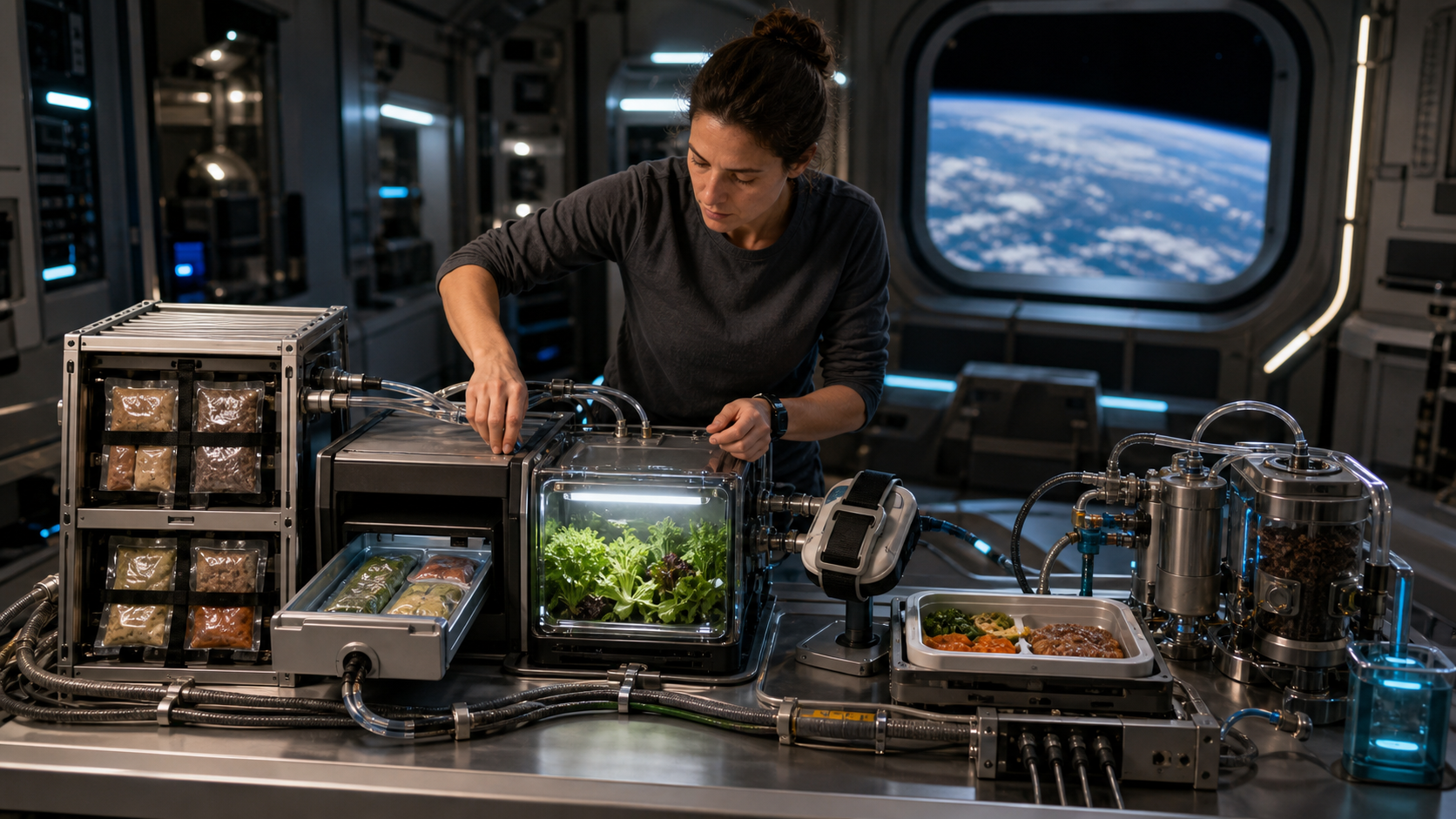
The architecture therefore points toward a mixed system rather than an ideological contest between pouches and plants. Stored food supplies calories, predictability, and menu structure. Cold stowage, packaging, and formulation may protect vulnerable items. Fresh production may replenish selected nutrients, textures, and sensory experiences. Each option brings a different bill in mass, power, water, volume, thermal rejection, sanitation, waste, labor, and failure recovery. The design problem is to assign each function to the method that delivers it best for a particular mission phase.
NASA's June 2026 Human Research Program Research Approach Plans turn that architecture into research questions. FN-103 asks how temperature affects nutritional content, safety, and acceptability. FN-206 addresses using food as a countermeasure against decrements in nutritional status or mission-related effects on health and performance. The plan maps the Food and Nutrition Risk back to Gap 0305. Architecture identifies the missing capability. Human research identifies the unresolved consequence. Experiments must supply the measurement that connects them.
FN-206 sets a particularly useful evidentiary threshold. A food is not a countermeasure because it contains a promising compound. The compound must survive storage or production, remain in the edible portion, reach the plate, be consumed at a measured dose, and change a predefined endpoint against the background diet and mission exposure. That sequence makes intake tracking central, not administrative. Without it, a null health result cannot distinguish failed biology from an intervention that never arrived in sufficient quantity.
The National Academies' 2023 decadal survey widens the boundary further through a proposed Bioregenerative Life Support Systems campaign. Food production sits beside air and water renewal, waste processing, and critical-material generation. The report does not promise a fully closed biological loop on a near-term schedule. It describes modules that may augment parts of physicochemical life support and generate evidence for larger systems. A crop can contribute without closing the habitat. A small module can supply selected foods without supplying all calories.
Mission duration changes which part of the chain deserves emphasis. A short lunar visit may not justify fresh production on calories, yet it can validate intake tracking, food-safety procedures, sample handling, cultivation operations, and low-burden crew interaction. A month of surface operations makes repeated use, menu behavior, maintenance, and temperature exposure more consequential. A Mars-class mission turns storage, production, nutrient recovery, waste integration, and autonomy into one architecture. Experiments should scale their claims as deliberately as their duration.
This is where a common data packet becomes more valuable than another isolated demonstration. Crop identity, lot, environment, edible yield, nutrient assay, microbial result, portion offered, portion consumed, crew time, power, water, waste, uncertainty, and outcome should travel together. The same packet can describe stored food, fresh food, or a mixed system. NASA can then compare evidence across hardware concepts without deciding the full architecture in advance.
Gastronaut has prepared three public-safe starting points: a Crop-to-Crew Minimum Dataset, a Crop Readiness Self-Assessment, and a Crop-System Resource Accounting Template. The specific request is for NASA HRP, food-system, and Moon-to-Mars architecture staff to choose one child gap and test whether those fields expose the evidence needed for a decision. The templates are proposals for technical review, not NASA requirements.
Gastronaut's own maturity must remain separate from the architecture fit. ORCA is a ground-stage variable-gravity cultivation research platform at TRL 3 to 4 and has not flown. Gastronaut reports 1,042 ground growth cycles over approximately 18 to 24 months. That internal operating archive is not flight evidence and does not establish edited-line performance. Alignment with a named NASA gap does not confer selection, procurement intent, or technical validation.
Gap 0305 matters because it refuses to let one successful harvest stand in for a food system. The number on the page is not a destination. It is the address of a chain NASA has already decided must be measured end to end.
Research foundation and evidence boundaries
The gap structure, ratings, mission traceability, and current-state statements come from NASA's Revision C architecture and June 2026 HRP plan. The National Academies report supplies a consensus research roadmap, not an agency commitment. Gastronaut owns the cross-document synthesis and proposed common packet. ORCA remains at TRL 3 to 4 on the ground, has not flown, and carries no NASA validation or present human-health claim.
References
- NASA, "Moon to Mars Architecture Definition Document, Revision C," 2025, NTRS 20250010956. https://doi.org/10.64631/LQVW3671 and https://ntrs.nasa.gov/citations/20250010956
- National Academies of Sciences, Engineering, and Medicine, "Thriving in Space: Ensuring the Future of Biological and Physical Sciences Research, A Decadal Survey for 2023-2032," 2023. https://doi.org/10.17226/26750
- NASA Human Research Program, "Research Approach Plans, June 2026," Food and Nutrition Risk Approach Plan. https://www.nasa.gov/wp-content/uploads/2026/06/hrp-rap-for-web-62026.pdf
- NASA Human Research Program, "Risk of Inadequate Food and Nutrition Causing Decrements in In-Mission Health and Performance and Long-Term Health." https://www.nasa.gov/directorates/esdmd/hhp/food-and-nutrition-risk/
- Gastronaut, Crop-to-Crew Minimum Dataset, August 23, 2026.
- Gastronaut, Crop Readiness Self-Assessment, August 23, 2026.
- Gastronaut, Crop-System Resource Accounting Template, August 23, 2026.