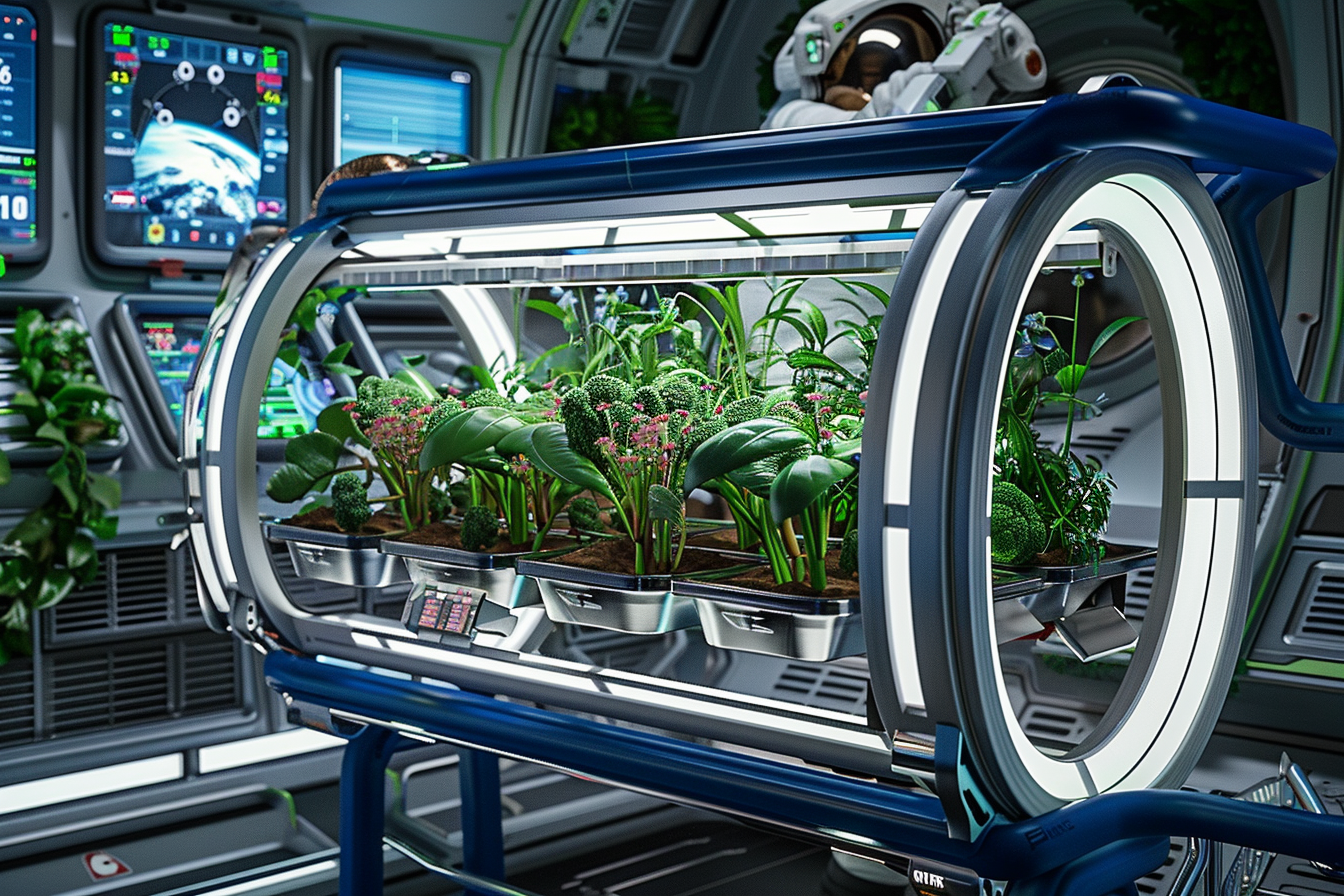
You can leave the espresso machine.
You can leave the good chair.
You can, if you are made of sterner stuff like most of us, leave Earth.
You cannot leave the plants.
This is not a lifestyle opinion. It is not a plea from people who own too many watering cans. It is what happens when a human body is asked to spend months or years in a metal can whose pantry was packed on a Tuesday in Florida and then asked to behave like food all the way to Mars. Packaged calories survive that trip. A lot of the chemistry that makes those calories useful does not. Fresh vegetables and herbs are how you put that chemistry back in the cabin without inventing a new organ.
Like it or not, the kale is on the manifest.
The world’s most expensive pantry still goes stale
Space food is a triumph of packaging, and packaging is a truce with time. You stabilize, you freeze-dry, you retort, you foil-laminate, you congratulate yourself, and then the vitamins start resigning. Stored space rations lose the fragile things first. Vitamin C is a notorious quitter. Thiamine and other B vitamins drift. Folate and some of the more photogenic antioxidants do not improve with a year in a locker. NASA and the military have known this for decades; it is why “shelf-stable” and “nutritionally complete” are not synonyms. A menu can hit its calorie target on day 400 and still be a polite way to underfeed a nervous system. That would be a footnote on a seven-day lunar hop. It is the plot on a Mars campaign. Outbound transit is on the order of six to nine months. Surface time is not a weekend. The ride home is another six to nine months.
By the time someone opens the last pouch of “chicken” that was packed before launch, that pouch has been aging in a radiation environment no earthly warehouse has to imitate. Fortification on the pad helps. It does not freeze the food in the state your grandmother would call dinner. Crews already run hot on this problem in low Earth orbit. Energy intake on station is a known soft spot. People eat less than the plan, the plan was already a compromise, and then the micronutrients in the plan quietly leave. You can hand someone a multivitamin. You cannot hand them the matrix those vitamins came in: fiber, polyphenols, living plant tissue, the smell of something that was a seed last week. Anyone who has lived on instant noodles during finals week already understands the physics.
The body notices the difference.
So does morale.
Fresh is not a garnish. Fresh is a delivery system.
A dehydrated carrot is still, in the taxonomic sense, a carrot. A living leaf is a different object. Plant cells keep their own factories running until you cut them. Lets get a bit scientific here so the premise can be understood. Glucosinolates in broccoli and other brassicas sit in one compartment; the enzyme that unlocks them, myrosinase, sits in another. Chew the leaf and you get sulforaphane, a compound that has an actual job after you swallow it: it talks to the Nrf2 pathway, the cell’s built-in response to oxidative insult. That pathway is not a wellness brand. In spaceflight mice, losing Nrf2 made the inflammatory and vascular damage of flight worse.
The plant is not “an antioxidant” in the smoothie-bar sense. It is a small, edible switch. You do not get that switch out of a two-year-old pouch in the same way. The precursor can degrade. The enzyme can die in processing. The serving that looked good in a nutrient database in Houston is not the serving in the crew’s mouth. Herbs are the same story with better branding. Parsley and cilantro are not there to make the rehydrated stew look like a restaurant committed a crime. They are concentrated sources of vitamin K, folate, and a swarm of volatile oils that do not survive retort well. Basil and mint are miniature pharmacies that also happen to smell like a planet. Thyme and rosemary carry phenolics that look boring on a spreadsheet and useful in a body that is soaking radiation and rearranging bone.
Microgreens, the seven-day-old version of vegetables you already know, are the cheat code. They pack, in a few centimeters of stem and leaf, nutrient densities that often dwarf the mature plant for vitamin E, vitamin C, vitamin K, carotenoids, and, in the brassicas, those glucosinolates. You are not waiting 70 days for a head of cabbage. You are harvesting a salad that has been alive since last Thursday. If you are designing a spacecraft, “last Thursday” is the most beautiful phrase in agriculture.
Interplanetary travel is an oxidation hobby
Take a mammal that evolved under 1g, a magnetosphere, and a diet that included things that had recently been in dirt. Put it in free fall. Add galactic cosmic rays and solar protons. Watch reactive oxygen species throw a party. The catalog is not subtle. Bone unloads. Muscle clock-watches. The immune system gets weird. The gut lining gets leakier than mission assurance would like.
The eyes; Spaceflight-Associated Neuro-ocular Syndrome, reminds a surprising fraction of long-duration crew that the skull is a fluid system and the retina did not sign up for this. A previous episode predicts the next one, which is nature’s way of saying the model is consistent and you will not enjoy that. None of this is fixed by adding more beige protein to the locker. Some of it is helped by what plants do for free. Fiber and polyphenols feed the microbiome.
The microbiome talks to the brain. In at least one simulated-microgravity rodent model, transplanting the disrupted gut community was enough to export cognitive trouble into a healthy animal, and diet could push back.
That is not “lettuce is a psychiatrist.” That is: if you starve the gut of living plant matter for 18 months, you are running an uncontrolled experiment on the same wetware that has to land the ship.
Vitamin C and carotenoids are not optional decorations on that list. They are consumed in the work of mopping up oxidative damage. When the stored supply fades and the radiation does not, the deficit is not theoretical. Fresh tissue replaces what the pouch lost and adds the compounds processing never packed. Calcium in space-grown produce is its own small tragedy. Flight greens have been measured leaner in minerals than their Earth twins -calcium drops of tens of percent show up in the literature, with similar sulks from magnesium, iron, and some of the pretty flavonoids. If you grow a plant in the wrong mechanical environment, it does not bother to load the leaf the way a garden does. That is one reason “we grew lettuce on station” and “we solved crew nutrition” are different sentences. The plant has to be grown as if bones still matter.
Why not just ship a bigger box of pills?
Because pills are not dinner, and dinner is not optional. A tablet can carry ascorbic acid. It cannot carry the chewing, the water, the scent, the small ritual of not living inside a vending machine. ISS crews have been unusually clear about this. Pick-and-eat crops score as meaningful work. Affect goes up as the mission wears on, which is the opposite of most hobbies you can pursue in a sock. Earth horticulture-therapy literature finds a real depression-effect size; applying that number to a Mars crew is an inference, not a flight result, and it is still a better inference than “the crew will simply enjoy the pouches more.” There is also the unromantic mass budget. Every vitamin bottle you pre-position is mass you boosted out of the gravity well and then stored against a clock. Every kilogram of living crop system is mass that makes more kilograms while you watch. Bioregenerative systems are not cheaper on day one. They become the only adult option when the mission is long enough that resupply is a folk tale.
The 2023 National Academies decadal survey for NASA’s biological and physical sciences division did not whisper this. It named Bioregenerative Life Support Systems a flagship research campaign for the decade: high-quality food, refreshed air and water, processed waste, plants and microbes earning their keep so a crew can live farther than the pantry. That is not a farmer’s market manifesto. That is the National Academies telling the space agency that the salad is infrastructure. NASA Kennedy Space Center has been running a microgreens program since at least 2020 and, in 2025, its own project scientist said the quiet part: microgreens are not flight-ready yet. The next work is flight-forward hardware, food safety, and as many collaborations as will pick up a hose. Fertigation-as-biofortification, basically, can we just fertilize harder, did not produce a result they were willing to hang a talk on. Light-spectrum tricks move vitamin C and K a little. A little is not a Mars menu.So the plants are coming. The only open argument is whether they come as a science payload that sometimes gets eaten, or as a food system that happens to do science.
Herbs, or how to keep a crew from becoming a closed ecosystem of complaint.
It is easy to defend kale.
Kale looks like a countermeasure. Herbs look like a garnish, which is how people who have never been trapped with the same seven entrees talk. A Mars crew will not mutiny over protein. They will start writing long messages home about flavor.
Flavor is chemistry.
The volatiles in basil, the bite in mustard greens, the ridiculous perfume of mint in a volume of recycled air — those are neurological events. They also happen to ride along with micronutrients the pouches are bad at. Cilantro is folate and vitamin K and a personality test. Chili leaves and peppery microgreens change saliva and mood in ways no program manager put in the requirements document. Green onions do more for a bowl of rehydrated something than another decade of packaging research. This is the part where a certain kind of engineer says, “That’s not nutrition, that’s psychology.” Correct. It is both.
A crew that will not eat the plan is a crew in calorie deficit, and calorie deficit on orbit is already in the record. Palatability is a nutrient-delivery device. Herbs are how you hack palatability without adding another industrial freeze-dryer to the vehicle. If that sounds unserious, try six months of beige and then tell the plant people they are being sentimental.
Plants would also like a word about gravity
Plants did not evolve for the ceiling to be a suggestion. They use weight the way we use a calendar. Roots go one way, stems the other, hormones ride the gradient, minerals follow the water. In free fall the plant still grows, Veggie and the Advanced Plant Habitat have made that point, but it grows like a committee. Water clings. Air does not rise. Ethylene, the plant’s own aging signal, can hang around a cabin at concentrations that have historically been unkind to wheat. One of the more unsettling findings in the older flight literature is that some “microgravity” plant symptoms still showed up on an on-orbit 1 g centrifuge, which is a polite way of saying the cabin, not the cosmos, may have been the villain. A rotating growth enclosure is not a fetish. It is how you give a leaf a down. Partial gravity is its own country: the Moon’s 0.17 g is not “microgravity but friendlier.” It is a mechanical environment that can confuse meristems in ways free fall does not. If you want a plant to load calcium into a leaf as if a human skeleton will later steal it, you may have to spin the rack. This is the unglamorous future. Not a geodesic dome on Mars with a folk guitar. A sealed cartridge, a light column, a drum that turns at a boring number of revolutions per minute, a tray of broccoli microgreens that were seeds when you were fighting with the printer. Harvest on day seven. Eat them before the vitamins remember they have somewhere else to be. Gastronaut’s ORCA work lives in that sentence: variable gravity so the crop keeps its minerals, brassica chemistry so the crew gets more than crunch, a growth cycle short enough to belong on a vehicle. The fancy words, Nrf2, glucoraphanin, Crop Readiness Level, are just the adult names for “grow the thing that still works after the freezed dried pouch gives up.”
What “better nutritionally” actually means in orbit
Strip the romance and the case for fresh vegetables and herbs is four stacked facts.
First, stored food loses the expensive micronutrients on a clock the mission cannot pause. Fresh tissue resets that clock every harvest.
Second, plants manufacture compounds processing destroys. Sulforaphane from fresh brassicas is the clean example. You can pill the idea. You cannot currently pouch the whole trick at the same fidelity.
Third, the crew is not a flask. Fiber, water, flavor, and the act of picking dinner change intake. Intake is the first nutrition requirement. Everything else is commentary.
Fourth, the vehicle cannot restock. Once you are past the Moon’s laundry cycle, every milligram of vitamin C you did not grow is a milligram you should have launched, stored, shielded, and prayed over.
Plants invert the arithmetic. They turn air, water, nutrients, and power into food continuously.
They also, as a side hustle, eat carbon dioxide and exhale oxygen, which is the sort of roommate behavior life support notices. None of that requires a speech about the human spirit. It requires a scale and a mission duration. Apollo could treat food as cargo. Artemis already stretches the rubber band. A lunar polar stay of weeks is a campervan. Mars is a cabin you cannot leave. Campervans people can live on jerky. Cabins grow a window box or they start making poor decisions.
Like it or not, Plants are coming along for ride.
There will be meetings in which someone argues that plants are messy, that roots in space are a fluids problem, that fungi will throw a house party, that crew time per kilogram is a scandal, that a vitamin-fortified brick is simpler. They are not wrong about the mess. EDEN-ISS, a serious analog greenhouse in Antarctica, logged on the order of six crew-member hours per kilogram of edible biomass.
Biosphere 2 once spent nearly half its human labor budget on growing and processing food.
Plants are not a software patch.
They are livestock that do not blink.
They are still coming. They are coming because the decadal survey already wrote them into the decade. They are coming because Kennedy Space Center already tried to get microgreens flight-ready and published the gap. They are coming because a pouch is a photograph of a vegetable, and a photograph does not do chemistry in your gut. They are coming because the first crew that eats a living leaf between Earth and Mars will not go back to explaining why the brick was fine.
Pack the seeds.
Pack the lights.
Pack the ridiculous little herbs that make the recycled air smell like a planet that still has the ability to make weather. The spacecraft can be as modern as it wants.
The mammal inside it is a Pleistocene animal with a doctorate, and that animal was promised dinner.
Plants are how we keep the promise.