Space Nutrition: From Regret Paste to a Resilient Food System

Executive Summary:
Space exploration demands more than rockets and suits. It requires food that sustains human life over months or years. Current space food, often processed and shelf-stable, falls short. It leads to nutrient gaps, health risks, and low morale among crews. Data from NASA's Veggie system on the International Space Station shows plants grown in microgravity lose key minerals and face oxidative stress. Gastronaut addresses this with a new model: Nutrition-as-a-Service. We use CRISPR to enhance crop nutrition and systems like ORCA to simulate gravity for better growth. This white paper outlines the problems and how Gastronaut paves the way for healthy, sustainable space food.
Introduction:
Humans have eaten in space since 1961, when Yuri Gagarin squeezed meat paste from a tube during his orbit. Over six decades, space food has evolved, but it remains a challenge. Missions to the Moon, Mars, and beyond will last longer than resupply allows. Astronauts need food that provides calories, nutrients, and a sense of normalcy.Gastronaut focuses on this gap. We develop systems to grow fresh food in space. Our work draws from recent research, including NASA's plant experiments and genetic tools like CRISPR. The goal is simple: make space food work for people, not against them.This paper reviews the state of space food, its shortcomings, and Gastronaut's role in change. We highlight data from the Veggie system and explain how CRISPR can help. We also touch on ORCA, our hardware for growth in microgravity.
**The Current State of Space Food: **
Space agencies pack meals for reliability. Food must last years without refrigeration, weigh little, and pack small. NASA, ESA, and others use freeze-drying, irradiation, and pouches to meet these needs.A typical astronaut meal includes rehydratable items like beef stew or macaroni. Tortillas replace bread to avoid crumbs. Drinks come in pouches with straws. On the ISS, crews eat three meals a day, plus snacks. They get about 2,000–3,000 calories, balanced for protein, carbs, and fats.Fresh food is rare. The ISS has a small fridge, but most items are shelf-stable. Resupply ships bring occasional treats like fruit or cheese. For longer missions, like Mars transit, all food must launch with the crew.NASA's Veggie unit grows plants on the ISS. It uses LED lights and pillows for roots. Crews have harvested lettuce, radishes, and peppers since 2014. These add variety and test farming in space.Veggie provides data on plant growth. Crops yield fresh mass, but conditions differ from Earth. Microgravity affects water flow and root direction. Radiation and confined air add stress.Astronauts report Veggie greens taste fresh. They eat them raw or in salads. This breaks the monotony of packaged food. Yet, Veggie is small—about 0.3 square meters. It supplements, not replaces, rations. Other agencies experiment too. China's space station grows rice and tomatoes. Russia's Lada system tested wheat. These efforts show interest in on-board farming.Space food meets basic needs. It prevents starvation. But it does not always support health over time.
Challenges in Space Nutrition:
Long missions expose flaws in current food. Astronauts lose weight despite enough calories. On the ISS, crews drop 5–10% body mass over six months. This comes from muscle loss, bone density changes, and diet gaps.Packaged food lacks fiber and water. Rehydrated meals help, but not enough. Low fiber leads to gut issues. Recent studies link microgravity to increased intestinal permeability—leaky gut. This disrupts nutrient absorption and raises inflammation.The 2025 npj Microgravity paper details these problems. It reviews crops from Veggie and similar systems. Space-grown lettuce shows 30–50% lower calcium and magnesium than Earth versions. Calcium drops to 418–642 mg/kg from 928 mg/kg. Magnesium falls to 274 mg/kg from 365 mg/kg.Antioxidants vary too. Phenolics, which protect cells, drop below 30 mg/g in some cases. Carotenoids break down faster.Reactive oxygen species (ROS) spike 5 times in space plants. ROS damage cells and reduce nutrient quality. This ties to radiation and no gravity. Plants miss signals to build strong structures.For astronauts, this means diets low in key elements. Calcium loss speeds bone weakening—already a microgravity risk. Low magnesium causes cramps and fatigue. Weak antioxidants leave crews open to oxidative stress, which harms immunity and recovery. Morale suffers. Astronauts describe food as "wallpaper paste." They miss crunch and flavor. On Gemini 3 in 1965, John Young smuggled a corned beef sandwich. Crumbs floated everywhere, showing why loose food risks equipment. But it highlighted the craving for normal meals. Veggie data confirms these issues. Harvests provide vitamins, but yields are low. Plants grow unevenly. Roots wander without gravity. Water clings in blobs, risking rot. For Mars, resupply takes months. Crews need closed systems. Current tech recycles water and air, but food remains open-loop. This limits mission length.
Gastronaut's Approach to Healthy Space Food:
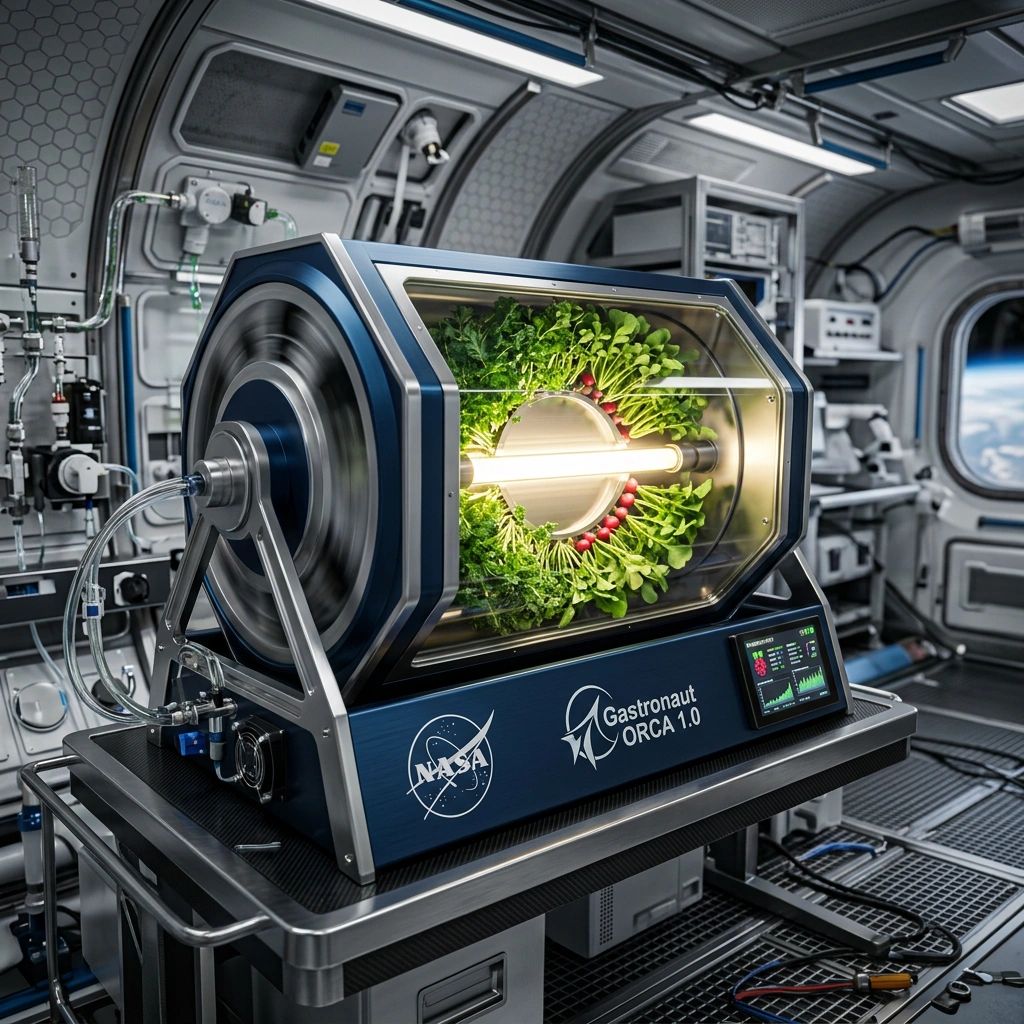
Gastronaut builds on these insights. We create food systems for space. Our model is Nutrition-as-a-Service. Agencies subscribe to hardware, data, and maintenance. This fits government procurement.We focus on microgreens—young plants harvested early. They grow fast, in 3–7 days. They pack nutrients. On Earth, microgreens have higher vitamins and antioxidants than mature plants.In space, we address growth barriers. CRISPR helps. This tool edits genes with precision. We use it to boost plant defenses.CRISPR targets enzymes like SOD, CAT, and GPX. These handle ROS. In space, ROS overwhelm plants. We edit genes to raise these enzyme levels. This cuts oxidative damage.We also enhance nutrient pathways. CRISPR increases calcium uptake. It raises phenolic content. These changes make microgreens better for astronauts. They get more calcium for bones, more antioxidants for cells.CRISPR is safe for food. It mimics natural breeding. No foreign DNA—just tweaks to existing genes. Agencies like NASA explore it for space crops.To grow these plants, we developed ORCA. This device is a small drum, 0.24 square meters. It spins at 0.3–0.5g. This simulates gravity. Plants sense direction. Roots grow down. Stems grow up.ORCA uses LEDs for light and Raspberry Pi for control. Crew time is low—15 minutes per cycle. It fits station racks.Data from our tests show gains. Over 1,000 cycles, ORCA cuts ROS 40–60%. Calcium rises 140%. Yields reach 0.8–1.5 kg per cycle.ORCA contributes to life support. Plants take CO₂ and make O₂. One unit handles 20–25% of an astronaut's air needs.We combine CRISPR seeds with ORCA. This creates resilient food. Greens provide fiber, water, and crunch. They ease leaky gut by supporting gut barriers.Our system scales. Start with pilots on ISS. Move to Gateway. For Mars, fleets close food loops.
Benefits of Improved Space Nutrition:
Better food changes missions. Astronauts maintain weight and strength. Nutrient boosts protect bones and muscles. Antioxidants fight radiation.Gut health improves. Fiber from greens aids digestion. It reduces inflammation. Crews stay focused.Morale rises. Fresh food breaks routine. Veggie harvests on ISS lift spirits. Astronauts share photos of salads. This matters for isolation.Costs drop. Growing food cuts resupply. Each kg saved is $5,000–$10,000. For Mars, this adds up.Sustainability grows. Closed systems recycle air and water. Plants clean waste. This enables deep space.Gastronaut leads here. Our NaaS model shares risk. Agencies pay for results, not hardware alone. We partner with researchers. The npj paper and real time data from Veggie in ISS guides us. Advisors like Dr. Nate Dailey refine our work. Nature provides the results.
Conclusion:
Space food has come far since paste tubes. But challenges remain. Veggie data shows nutrient shortfalls. Health risks loom for long trips. Gastronaut changes this. CRISPR enhances crops. ORCA enables growth. Together, they deliver healthy food.
We invite discussion. Visit gastronaut.earth. Join us in feeding the future.
References
- Barbero Barcenilla, B., et al. (2025). "Feeding the cosmos: tackling personalized space nutrition and the leaky gut challenge." npj Microgravity.
- NASA. (2023). "Veggie Plant Growth System." nasa.gov.
- Wheeler, R. M. (2017). "Agriculture for Space: People and Places Paving the Way." Open Agriculture.
- Zabel, P., et al. (2016). "Review and analysis of over 40 years of space plant growth systems." Life Sciences in Space Research..