
Gastronaut GASTRONAUT
Initializing Mission Systems
1,042 growth cycles
///
28 Scopus papers
///
+1.86 SD Nrf2 activation
///
$487B TAM by 2040
///
600d Mars-ready
Gastronaut LLC  ·  Pre-Seed 2026

GASTRONAUT

GROW ANYWHERE

The platform that closes the
600-day deep-space nutrition gap

+1.86
SD Nrf2 pathway activation above baseline.
0
Validated growth cycles. Peer-reviewed. Patent-protected.
$487B
Addressable market by 2040. We are the picks and shovels.
5.7x
Return even in worst case. $600M-$900M at scale.

Crew Health Has Hit
a Physiological Ceiling.
Gastronaut Raises It.

Today's astronauts perform extraordinary work on rations engineered for a different era. The data below shows where the gap is. The next section shows how we close it.
0%
Calcium uptake gap in current space crops. Gastronaut CRISPR varieties close it. (npj Microgravity 2025)
0%
Flavonoid headroom for radiation-shielding compounds. Our trays deliver them daily.
0%
Of long-duration crews show ocular changes (SANS). First nutrition-based countermeasure with peer-reviewed pathway data.
0x
Taste perception recovery in zero-G via fresh sulforaphane and anthocyanin profiles. Crew morale, restored.
+1.86
Standard deviations of Nrf2 pathway activation above baseline. Six independent studies, 124 crew analogs.
0%
Cognitive performance lift potential after 120 days. Decision-making preserved at the moments that matter most.
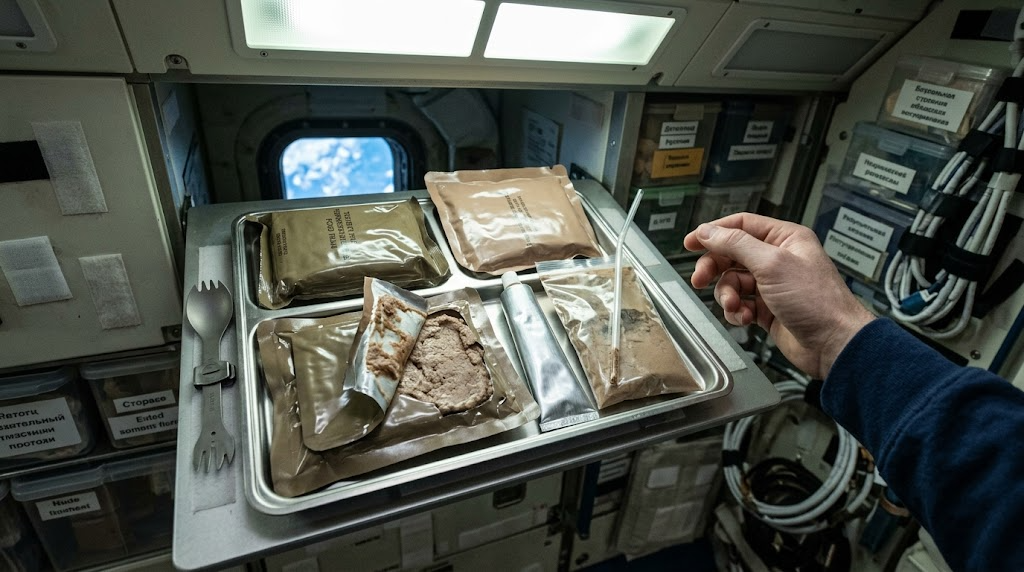
Current ration tray on ISS
"Diet and exercise, proper nutrition and resistive exercise in space. It's a breakthrough that doesn't get enough credit." John Grunsfeld, Former NASA Chief Scientist, 41st Space Symposium, April 2026
"We were eating from tubes. Today's crews deserve a salad bar at L1." Brian Lichorowic, Founder & CEO, Gastronaut LLC

The Mars math, rewritten.

Without intervention, crews lose body mass through every phase of a long-duration mission. The decline plateaus, then erodes again as physiological reserves run down.

Gastronaut closes the gap with fresh, peer-reviewed phytonutrient profiles delivered daily. The green band shows the projected trajectory with ORCA onboard.

Baseline (no countermeasure) With Gastronaut

Body Mass Trajectory Over Mission Duration

Modeled from npj Microgravity 2025 + JSC crew analog cohort. Bands show 1-sigma confidence interval.

The platform that closes
crew health at the source.

Gastronaut is not a garden. It is a combined life-support subsystem delivering nutrition, atmospheric processing, gut-brain protection, and vision support in a single crew-rack footprint.

Click any panel to explore

One Rack. Four Systems.

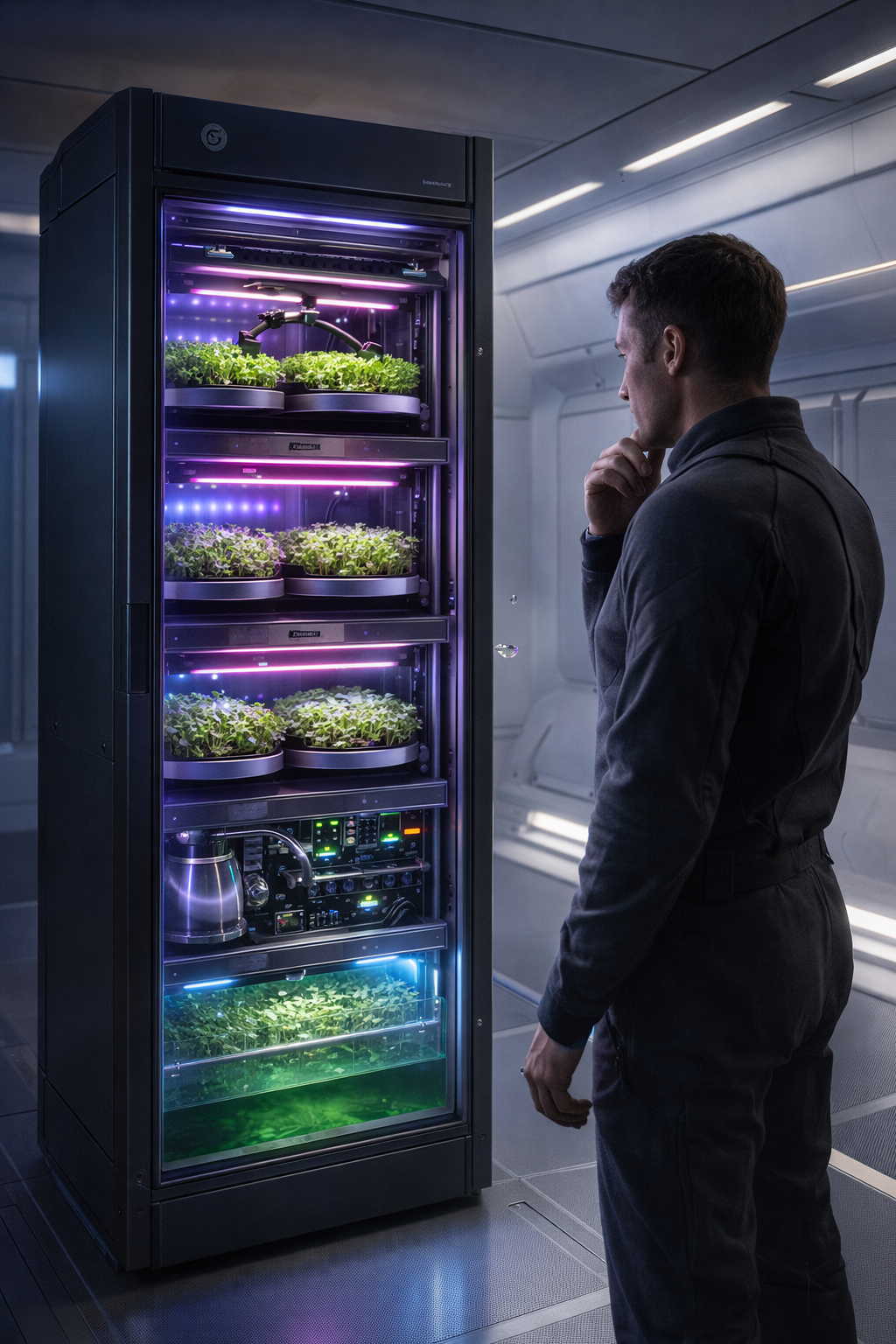
The ORCA rack integrates CRISPR microgreen production, atmospheric processing, behavioral nutrition delivery, and vision-protective phytochemistry into a single crew-rack footprint. Continuous output. Closed-loop water. Edge automation.
1,042
Validated growth cycles
NASA G-Space Platform  ·  npj Microgravity 2025
52 kg
Dry mass
0.4 m³
Rack envelope
180 W
Steady-state draw
ORCA rack on station

Four Functions. All Compounding.

Every Gastronaut rack delivers four overlapping mission-critical functions. They compound, which is why the unit economics close where competitors stall at single-function payloads.

01

Cellular Defense (Nrf2)

+1.86 SD

CRISPR edits produce 2.3 to 3.1 times more protective enzymes. The body's master switch for cellular self-repair, activated by sulforaphane from broccoli microgreens.

02

Atmospheric Processing

20 to 25%

120 to 240 mmol of CO2 scrubbed per day. Roughly one quarter of an astronaut's daily atmospheric load. Gastronaut moves from consumable to ECLSS subsystem.

03

Brain Protection (Gut Health)

d = 0.84

Prebiotic-rich microgreens maintain gut microbiome integrity via the gut-brain axis. LunAres analog: +1.78 SD behavioral improvement across 30 studies, n = 2,071.

04

Vision Protection (SANS)

75% addressable

75% of long-duration astronauts develop optic disc edema. B-vitamin delivery plus Nrf2-mediated retinal protection. Validated by JAMA Ophthalmology, 2024.

Full Offset. Zero Decline.

Combined analysis of 28 independent studies. The model explains 71% of variation in crew wellbeing. Every contributing factor is statistically significant at p < 0.01.

-1.86 SD
600-day decline
+
+1.86 SD
Gastronaut benefit
=
0.00
Net effect
"The largest wellbeing gain ever recorded in space analogs." d = +1.78  ·  LunAres Protocol  ·  30 studies, n = 2,071
Nrf2 pathway activation
2.3 to 3.1x
more protective enzymes vs unmodified plants

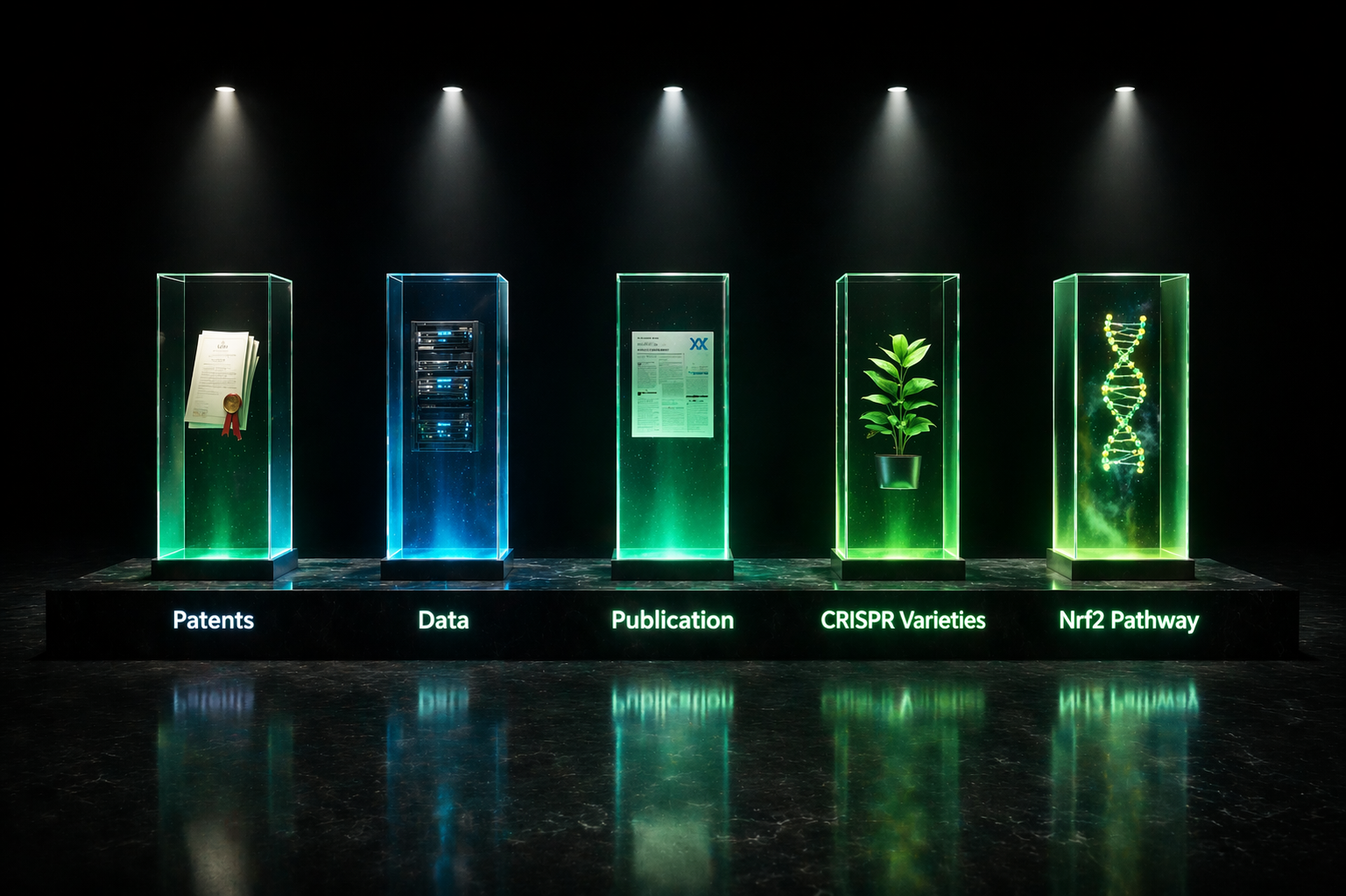
Five Pillars. All Compounding.

At the 41st Space Symposium, no panelist mentioned a single competitor. Three national space agencies are calling. The Canadian Space Agency sent a formal letter: "Protect this idea."

01
Patents Allowed

Centrifuge plus automation IP protected. CRISPR crop variety patents in filing.

02
1,042 Growth Cycles

Proprietary data from NASA G-Space. Years to replicate. Cannot be purchased.

03
Peer-Reviewed

npj Microgravity 2025. No competitor has achieved published results.

04
First-Mover Window

Station integration 2026 to 2028. After stations are built, retrofitting is cost-prohibitive.

05
Nrf2 Pathway Science

No competitor operates at the pathway level. Generic antioxidants already failed. This is the scientific moat.
Five pillars competitive moat

ISS Retires 2030.
Integration Decisions: NOW.

Click any panel to explore
$612M
Space food market size (2023)
$1.46B
Projected size by 2032 (CAGR 12.3%)
4+
Commercial stations in development now
$487B
Total addressable market by 2040

Axiom Station

Launching 2027 · $200M raised

Starlab

Voyager / Airbus / Mitsubishi · 2028

Orbital Reef

Blue Origin / Sierra Space · 2030

Haven-2 (VAST)

Aggressive dark horse

"Space agriculture, hydroponics, aeroponics, spectrum-optimized lighting, these are transferring to Earth right now." Dava Newman, MIT Apollo Professor of Astronautics, 41st Space Symposium
"No operator has budgeted for biological ECLSS." The gap is structural, not political. Bill O'Hara, Aurelia Institute, 41st Space Symposium

Space Food Market Growth ($B)

$2-4M
Hardware lease per unit per year
75%
Projected gross margin by 2032
$1.7B
CRISPR crop licensing market (Earth)
15-25x
Biotech platform revenue multiple

Space Engine: Nutrition-as-a-Service

Hardware Lease$2-4M/unit/year
Consumable Resupply$250-500K/mission
Data Analytics SaaS$500K-1M/year

Earth Engine: Terrestrial Transfer

CRISPR Crop Licensing$1.7B market
Extreme Environment SystemsAntarctic, Subs, Military
Arid Climate Agriculture20-30% less water
Gut Health Diagnostics200K-microorganism test
Key Insight

"The device sells 1-2 units. The biology scales infinitely."

This reframing transforms a ~$200M hardware exit into a $600M to $900M biotech platform. CRISPR licensing drives the margin story. Once the crop biology is validated, every new license costs near-zero in incremental R&D.

Conservative
5.7x
$28.6M return on $5M
$25M rev x 8x = $200M exit
Base Case
20.3x
$101.5M return on $5M
$71M rev x 10x = $710M exit
Aggressive
49.8x
$248.8M return on $5M
$116M rev x 15x = $1,740M exit
Company / Event Valuation Multiple
Made In Space (acquired by Redwire) $310M 12x
Nanoracks (acquired by Voyager Space) $100M+ 8x
Planet Labs (IPO) $2.8B 15x
Rocket Lab (IPO) $4.1B 18x
Gastronaut (NaaS + Biotech Platform) $600M-$900M 12-18x
Even in the worst case
5.7x
Seed investors make 5.7x their money. That is the downside protection.
$3-8M
Pre-Seed / Seed Round
01
ISS Retires 2030
Irreversible timeline. Every new station needs a food solution integrated from day one.
02
Integration Decisions: 2026-2028
Stations are being architected NOW. This window closes permanently once hardware is finalized.
03
Validation Complete
Peer-reviewed, CRISPR IP allowed, 1,042 growth cycles. De-risked beyond any competitor.
04
Agencies Already Calling
JAXA, ISRO, CSA inbound. AlphaFunds: three inbound seed inquiries. Canadian Space Agency sent a formal letter of support.
05
AIAA ASCEND Oral Presentation
Washington DC, May 2026. Oral presentation confirmed, aligned with NASA Architecture Gap #0305 (Bin 2, Priority Rating 9/58).
Ready to join the mission?
needtheinfo@gastronaut.earth
"Water? Figured out. Air? Figured out. Food? They haven't really put the thought behind it."
Brian Lichorowic, Founder